Pi Network Open Mainnet Migration Status 2026
The Pi Network mainnet migration status 2026 shows that Pi Network has moved from a closed app-based phase into a live Open Mainnet environment. The firewall was removed on February 20, 2025, which allowed external connectivity and PI trading on selected exchanges.
This transition matters because not every app balance becomes usable PI automatically. Users must complete KYC, activate their Mainnet wallet, and finish migration before they can access transferable PI on-chain.
By June 2026, Pi Network claimed about 60 million registered Pioneers. Around 16 million users had completed KYC, and roughly 16 million had migrated to Mainnet. For holders, migration is the key step that turns eligible PI into a real blockchain asset.
| Milestone | Date | Details |
| Enclosed Mainnet launch | December 2021 | Internal mainnet, no external trading |
| Open Mainnet firewall removed | February 20, 2025 | PI begins trading on external exchanges |
| PI all-time high | February 26, 2025 | $2.99 per PI |
| Total Pioneers claimed | 2026 | ~60 million registered users |
| KYC-verified Pioneers | June 2026 | ~16 million completed |
| Mainnet-migrated Pioneers | June 2026 | ~16 million migrated |
| Protocol 23 activated | May 11, 2026 | Soroban smart contracts enabled |
| Pi DEX target launch | Q2–Q3 2026 | Peer-to-peer on-chain trading |
Mainnet Migration Update and Progress
The latest Pi Network mainnet migration update shows steady but still phased progress. By early 2026, more than 16 million Pioneers had migrated to Mainnet, while Pi Network reported about 16.5 million KYC-approved and migrated users around Pi Day 2026.
Pi Network also showed strong ecosystem activity. Its KYC system recorded 526,970,631 successful human validations by 1,094,680 validators. The first validator rewards snapshot included 16,568,774 PI in the pool, tied to migrated users, although Pi Network has not published one exact total for all migrated PI balances.
Understanding Pi Network KYC Requirements
Pi Network KYC is required for Mainnet migration because the network must confirm that each account belongs to a real person. This helps Pi Network reduce bots, duplicate accounts, fake balances, and abuse before PI moves to the public blockchain.
KYC also protects the migration process. Only verified users can transfer eligible PI from the mobile app balance to the Mainnet wallet. Without approved KYC, a user may still see PI in the app, but they cannot fully access migrated PI on-chain.
Pi Network supports identity checks through the Pi app and Pi Browser. In 2026, the project also expanded verification with palm print technology. This method adds another human verification layer and helps confirm that one person controls one account.
KYC Status and Open Mainnet Access
The Pi Network KYC status and Open Mainnet 2026 process directly affect migration eligibility. If KYC shows as approved, the user can continue through the Mainnet Checklist and prepare the wallet for migration.
Users can check their status inside the Pi app or through the Pi Browser. Delays may happen because of unclear documents, name mismatches, regional queues, or extra verification steps. To resolve issues, users should review their KYC details, follow app prompts, and wait for official updates.
Step-by-Step Mainnet Migration Process
The Pi Network mainnet migration process is simple when you follow each step in the correct order. Beginners should not rush this process because wallet setup, KYC, and lockup choices affect access to migrated PI.
- Check your eligibility in the Pi app: Open the Mainnet section and review your Mainnet Checklist. The app shows which steps are complete and which still need action.
- Complete KYC verification: Pi Network must approve your identity before you can migrate eligible PI to Mainnet. If KYC is still pending, migration cannot move forward.
- Create and confirm your Mainnet wallet: Open Pi Browser, create your wallet, save the passphrase, and confirm the wallet address inside the Pi app.
- Set your lockup configuration: Choose how much PI you want to lock and for how long. A lockup can improve your mining rate, but it also limits immediate access to that PI.
- Complete the final migration confirmation: After all checklist steps are complete, confirm migration and wait for Pi Network to transfer eligible PI to your Mainnet wallet.
- Verify your balance after migration: Open your Mainnet wallet and check available, locked, and migrated PI. If your balance does not appear yet, your transfer may still be processing.
Mainnet Checklist Steps for Migration
The Pi Network mainnet checklist steps show every action required before migration. Users should complete them carefully because missing one step can delay access to Mainnet PI.
- Complete KYC verification inside the Pi app.
- Create your Mainnet wallet through Pi Browser.
- Save your wallet passphrase in a secure offline place.
- Confirm your wallet address in the Mainnet Checklist.
- Complete or review your Security Circle.
- Choose your lockup percentage and lockup duration.
- Accept the Mainnet token terms.
- Complete any required 2FA verification.
- Confirm the final migration step.
- Check your Mainnet wallet after migration.
Mainnet Wallet Activation Feature
The Pi Network mainnet wallet activation feature helps users create a wallet that receives migrated PI. You can activate it through Pi Browser.
- Open Pi Browser from the Pi app.
- Go to the wallet section.
- Create your Mainnet wallet.
- Copy and safely store your passphrase.
- Return to the Pi app.
- Confirm your wallet address in the Mainnet Checklist.
- Check whether the wallet activation step shows as complete.
Your passphrase controls access to your wallet. Never share it with anyone, and do not store it in places that other people can access.
Pi Network Mainnet Withdrawals
Pi Network mainnet withdrawals become possible only after migration. This means your PI must first move from the Pi app balance to your Mainnet wallet. Until then, you may see PI in the app, but you cannot send it like a normal on-chain asset.
After migration, users can transfer available PI to another Pi Network wallet, a supported external wallet, or an exchange that accepts native Mainnet PI. However, locked PI cannot be withdrawn until the lockup period ends. Users must also check wallet addresses carefully because blockchain transfers cannot be reversed.
Mainnet Withdrawal Process Explained
The Pi Network mainnet withdrawal process starts inside your Mainnet wallet. First, open Pi Browser, go to the wallet, and check whether your PI shows as available instead of locked.
- Copy the correct recipient address.
- Paste it into your Pi Network wallet.
- Enter the amount of PI you want to send.
- Review the address, fee, and amount.
- Confirm the transaction.
- Wait for blockchain confirmation.
- Check the receiving wallet or exchange balance.
Before sending PI to an exchange, confirm that the platform supports native Mainnet PI, not only IOU trading. Always test with a small amount first.
Trading Pi on Exchanges After Mainnet
The Pi Network mainnet exchange listing status changed after Open Mainnet allowed external connectivity. Users can now trade PI on selected platforms that support real Mainnet deposits and withdrawals. However, beginners must check each platform carefully before sending funds.
StealthEX gives users another way to exchange PI without creating a trading account. It works as a non-custodial swap service, so users send PI from their wallet and receive another crypto asset in their chosen wallet.
This setup can suit users who prefer simple swaps, direct wallet-to-wallet transfers, and no standard account registration. Still, users must first complete Pi Network KYC, migrate PI to Mainnet, and send only unlocked native PI.
IOU vs Native PI: What to Know Before Trading
IOU PI tokens are synthetic exchange balances that traded before full Open Mainnet access. They do not always represent real PI that users can withdraw to a Pi Network wallet.
Native Mainnet PI works differently. It is a real on-chain PI stored in a verified Mainnet wallet after KYC and migration. Users should always check whether an exchange supports IOU PI or native PI. Historical IOU and native PI prices have differed, while StealthEX exchanges only native Mainnet PI.
| Feature | IOU PI Token | Native Mainnet PI |
| What it is | Synthetic representation of PI on the exchange | Real PI migrated to the Mainnet blockchain |
| Requires KYC? | No | Yes — mandatory |
| Requires Mainnet migration? | No | Yes |
| Backed by a real PI? | Not always — depends on exchange | Yes, 1:1 on-chain |
| Price accuracy | May differ from the real PI market price | Reflects true market value |
| Can it be withdrawn to the Pi wallet? | No | Yes |
| Available on StealthEX? | No — StealthEX lists native PI only | Yes |
Open Mainnet Exchange Listing Status
The Pi Network open mainnet exchange listing market now includes several centralized exchanges and swap platforms. PI trades mainly against USDT, although some venues also support USD pairs. CoinGecko shows Gate as one of the most active PI markets, with OKX and Bitget also listed as popular options. Binance still marks Pi Network as “Not listed,” while Coinbase shows Pi Network as not tradable. Kraken now shows PI trading support, so users should always verify deposits, withdrawals, and native Mainnet support before moving funds.
| Exchange | PI Listed | Trading Pairs | Native PI | Notes |
| OKX | Yes | PI/USDT | Yes | One of the earliest listings |
| Bitget | Yes | PI/USDT | Yes | Active spot market |
| Gate.io | Yes | PI/USDT | Yes | One of the most active PI markets |
| MEXC | Yes | PI/USDT | Yes | Active trading |
| HTX | Yes | PI/USDT | Yes | Available on selected markets |
| Bitfinex | Yes | PI/USD, PI/USDT | Yes | USD and USDT pairs |
| StealthEX | Yes | PI ↔ 2000+ coins | Yes | No-KYC, non-custodial swaps |
| Binance | No | — | — | Not listed as of July 2026 |
| Coinbase | No | — | — | Not tradable as of July 2026 |
| Kraken | Yes | PI/USD | Yes | Spot trading support shown |
Pi Network Mainnet Price Today
The Pi Network mainnet price today sits near the $0.11–$0.12 range across major trackers, but prices can differ slightly by exchange. Kraken shows PI around $0.12, while MEXC reports a 24-hour range near $0.1135–$0.1174. CoinGecko shows daily PI volume above $8 million.
Troubleshooting Migration Issues
If you see Pi Network tokens missing Mainnet migration, first check whether your PI is available, locked, or still pending inside the Mainnet wallet. Some balances do not appear instantly because migration happens in batches, not all at once.
If KYC was rejected, review your name, ID document, photo quality, and app prompts. Submit corrections only through official Pi Network tools. If your migrated balance looks wrong, compare your transferable balance, lockup settings, and Security Circle rewards.
Never share your passphrase with anyone who claims they can “fix” migration. Use only the Pi app, Pi Browser, and official support channels.
Mainnet Migration Delay Reasons
The most common Pi Network mainnet migration delay reasons include KYC queues, technical checks, account review, missing checklist steps, and extra verification requests. Some users also wait longer because their region has more pending validations.
A delay does not always mean something is wrong. First, check your Mainnet Checklist, wallet confirmation, KYC status, and 2FA status. Then wait for the next migration batch. If the app asks for action, follow only official instructions.
Pi Network Development Roadmap and Timeline
The Pi roadmap now focuses on turning Pi Network from a mining app into a wider utility ecosystem. After Open Mainnet, the Pi Core Team moved attention toward protocol upgrades, app growth, Mainnet payments, token tools, and stronger developer support.
Future plans include more ecosystem utilities, broader wallet use, improved node performance, and governance features that can give Pioneers a clearer role in network decisions. The long-term vision is simple: Pi Network wants real people to use PI inside apps, commerce, DeFi tools, and AI-era products instead of treating the coin only as a speculative asset.
Mainnet Timeline and Future Updates
The Pi Network mainnet timeline started with Beta in 2019, Testnet in 2020, and Enclosed Mainnet in December 2021. Open Mainnet followed on February 20, 2025, when the firewall was removed.
In 2026, Pi Network added stronger KYC tools, Launchpad testing, Protocol 23, and more smart contract preparation. Future updates should focus on Mainnet app launches, ecosystem token tools, governance, Pi DEX, and better developer infrastructure.
Protocol 23 & Smart Contracts
Stellar Protocol 23 was activated on Pi Network Mainnet on May 11, 2026. It was the largest technical upgrade since Open Mainnet because it brought Soroban smart contracts to Pi Network.
This upgrade enables DeFi apps, Pi Launchpad projects, and the planned Pi DEX. It also moves Pi Network from a payment-focused blockchain toward a programmable blockchain. This connects with the Pi Core Team’s AI-era vision, where verified humans can power real utility. Pi DEX aims to support peer-to-peer PI trading without centralized exchanges.
Frequently Asked Questions
What Is the Mainnet Migration Guide for Pi Network?
The Pi Network mainnet migration guide explains how to complete KYC, activate the Mainnet wallet, confirm lockup settings, and transfer eligible PI. Users can find official steps inside the Pi app.
How Do I Withdraw Pi Coins from Mainnet?
To use Pi Network withdraw PI coins Mainnet features, open your Mainnet wallet, enter a supported wallet or exchange address, review the transaction, and confirm it. Always test with a small amount first.
What Is Pi Network’s Open Mainnet Price Prediction?
A Pi Network open mainnet price prediction depends on exchange liquidity, user migration, ecosystem growth, token unlocks, and market sentiment. Any PI forecast remains speculative because crypto prices can change fast.
What Are the Mainnet Migration Steps?
The Pi Network mainnet migration steps include completing KYC, activating your wallet, confirming your wallet address, choosing lockup settings, approving migration, and checking your Mainnet balance.
Follow us on Medium, X, Telegram, YouTube, and Publish0x to stay updated about the latest news on StealthEX.io and the rest of the crypto world.
Don’t forget to do your research before buying any crypto. The views and opinions expressed in this article are solely those of the author.
blockchain blockchain technology crypto world cryptocurrency KYCThe post Pi Network Open Mainnet & KYC: Complete Migration Guide 2026 first appeared on StealthEX.]]>
Aave’s Monad Debut Turns Incentives Into Instant Liquidity
Aave’s arrival on Monad gave DeFi traders a fast lesson in how quickly capital moves when rewards, infrastructure and narrative line up. The V3 market passed $100 million in deposits within two days, which shows that lenders still chase new opportunities when a chain offers low fees, quick execution and a clear incentive runway.
The early surge did not happen by accident. Monad committed major support for the launch, including millions in incentives and a large GHO position, while the Aave DAO added its own liquidity push. That mix helped lenders move before borrowing demand had time to prove itself, and it also gave market makers a reason to test Monad’s rails early.
The bigger question now sits on the borrower side. Deposits can arrive quickly, yet they only stay when traders, apps and liquidity desks actually borrow at scale. Risk teams have already adjusted caps, which should help limit concentration while the market matures. Lenders now need to watch utilization, oracle stability, cap changes and GHO activity, because rewards alone cannot build a durable lending market. If real borrowing grows before incentives fade, Monad may turn a fast launch into a lasting DeFi venue for serious crypto capital long-term.
Binance UK Perps Case Puts Global Derivatives Playbooks Under Pressure
A new legal fight in London could force crypto exchanges to rethink how they offer perpetual futures to users in restricted markets. Almost 1,700 UK investors have brought a coordinated claim against Binance-related entities and Changpeng Zhao, seeking at least £150 million over allegations that retail traders accessed leveraged crypto derivatives without the required UK authorisation.
The case matters because Britain has drawn a firm line around these products. Since 2021, the FCA has banned firms from selling crypto derivatives, including futures, options and CFDs, to retail consumers. Perpetuals may look simple inside a trading app, yet regulators treat them as high-risk derivatives because leverage, funding rates and round-the-clock volatility can punish inexperienced users quickly.
Whatever the court decides, exchanges that touch UK users will likely face more pressure to prove that their geo-fencing, onboarding checks, affiliate activity and product messaging actually work. The case also lands as the US tests regulated perpetual products, while Europe continues to separate MiCA’s spot-crypto rules from derivatives law. For traders, the practical takeaway feels clear: offshore access may become harder, regulated venues may gain ground, and platforms may redesign perps around location, permission level and compliance rather than pure trading demand alone.
eToro’s Extended Bet Brings On-Chain Perps Closer to Broker Apps
eToro’s investment in Extended signals that on-chain perpetuals are moving from DeFi-native dashboards toward mainstream trading interfaces. The broker led a $12.5 million round in the derivatives venue, which has reported more than $245 billion in cumulative trading volume and support for over 100 perpetual markets. That scale gives a large broker something serious to integrate rather than a small experiment.
The planned link with Zengo, the self-custody wallet eToro acquired, points to a bigger shift. Users may eventually open a broker-style app, connect or create a wallet, deposit collateral into smart contracts and trade perps without sending funds to a centralized exchange. The broker controls the screen, the education layer and the routing, while the user keeps custody through wallet-based flows.
That model could reshape competition in crypto derivatives. Centralized exchanges built the perp market through speed, leverage and liquidity, but brokers already own distribution and consumer trust. On-chain rails add transparency, programmable risk and wallet control, although traders still face oracle issues, gas costs and slippage during stress. If eToro can package Extended’s engine inside a clean user experience, broker apps may become the next major gateway into DeFi’s most active trading product for regular active users.
PUMP Unlock Sets Up a Weekend Test for Solana Meme Liquidity
PUMP holders face a key supply event on July 12, and traders are already debating how much pressure the market can absorb. One tracker points to about 19.17 billion PUMP entering circulation, equal to roughly 1.9% of total supply and worth around $31 million at referenced prices. Another view shows a much larger unlock value near $147 million when measured against float and broader recipient groups.
That gap matters because traders care less about headline tokenomics than about what actually reaches exchanges and DEX pools. If recipients hold, move tokens slowly or use private arrangements, the market may digest the event without major damage. If large chunks hit order books during quiet weekend hours, Solana’s meme liquidity could react sharply.
Pump.fun’s buyback program adds another layer to the setup. The platform has reportedly spent more than $400 million buying and burning PUMP, creating a real protocol bid that can soften selling pressure when activity stays strong. Yet buybacks depend on revenue, and revenue depends on launchpad traffic. The July unlock will therefore test more than one token. It will show whether Solana meme demand, platform fees and on-chain liquidity can handle fresh supply when traders move fast.
Zcash Tries to Turn Orchard Scare Into an Ironwood Reset
Zcash has moved from emergency repair mode into a more important trust rebuild. After developers disclosed a serious Orchard circuit issue in late May, the network pushed through the NU6.2 hard fork on June 3, 2026, at block 3,364,600. That upgrade corrected the circuit and brought shielded activity back online, while exchanges and infrastructure providers worked through temporary pauses around the transition.
The next step, Ironwood, aims to solve a deeper market problem: confidence in supply. The proposal introduces a new fixed Orchard-based shielded pool and a turnstile-style migration, which should let observers verify circulating supply without exposing private user activity. For a privacy coin, that balance matters because any security scare can quickly turn into fears about hidden inflation.
ZEC’s price already showed how sensitive the market remains. The coin dropped heavily after the disclosure, then rebounded as the patch landed and Ironwood entered the discussion. That bounce does not guarantee a comeback, but it shows traders still see optionality if the technical reset works. Wallets, exchanges and node operators now need to coordinate cleanly. If Ironwood activates smoothly and users migrate without confusion, Zcash can turn a painful incident into a stronger privacy-and-auditability story again.
Dormant Bitcoin Wallet Lawsuit Tests the Meaning of Digital Ownership
A New York lawsuit over thousands of inactive Bitcoin addresses could become one of the most important legal tests for self-custodied crypto. The case targets 39,069 wallets that plaintiffs want treated under unclaimed property principles, while the Digital Chamber has stepped in with another amicus brief warning that such a move could weaken digital property rights.
The dispute looks unusual because the numbers are enormous. Reports link the wallets to about 3.7 million BTC, worth hundreds of billions of dollars, and some observers have even suggested that certain addresses may connect to Bitcoin’s earliest era. That possibility adds drama, yet the real issue sits in the legal logic. If courts treat dormant wallets as abandoned property, owners of self-custodied assets could face uncertainty simply because they have not moved coins for many years.
Recent activity from some listed addresses complicates the picture. Thousands of BTC have reportedly moved from wallets named in the dispute, including coins that had stayed still for more than a decade. Even so, legal title does not equal technical control in Bitcoin. Without private keys, plaintiffs cannot actually spend the coins. The court may influence future property law, but cryptographic control will still decide who can move Bitcoin.
Bernstein Says Bitcoin’s Slide Still Falls Short of a True Cycle Collapse
Bitcoin’s latest drawdown has scared late buyers, but Bernstein does not see it as proof that the bull cycle has ended. Analyst Gautam Chhugani reportedly kept the firm’s $150,000 year-end target in place, arguing that the current fall from the October 2025 peak near $125,000 remains far smaller than the 75% to 90% crashes that ended previous Bitcoin cycles.
That comparison matters because Bitcoin has often looked broken before it resumed a larger trend. A 54% decline can destroy leveraged positions and shake confidence, yet it does not match the scale of the 2013, 2018 or 2022-style collapses. Bernstein’s view suggests the market has gone through a harsh reset rather than a full structural failure.
The call now depends on capital flows. Spot ETF demand, stablecoin liquidity, on-chain activity and exchange leverage will decide whether the recovery can gather speed. Institutional interest has not vanished, and money continues to move into tokenization, staking and payment infrastructure, which suggests crypto capital may have rotated instead of leaving completely. Still, Bitcoin needs a strong second-half rebound to reach $150,000 by year-end. Macro pressure, US policy debates and slow summer liquidity could delay the flow revival that Bernstein expects soon.
Strategy Turns Its Bitcoin Treasury Into an Active Capital Machine
Strategy has unveiled a Digital Credit Capital Framework that changes how the market reads its Bitcoin treasury strategy. The company still presents Bitcoin as its main reserve asset, yet its new plan adds liquidity tools, buybacks, dividend adjustments and potential BTC monetization at a time when its stock has fallen sharply.
The framework includes a US dollar reserve, a higher STRC dividend rate, buyback programs for preferred securities and common stock, plus authority to sell up to $1.25 billion in Bitcoin. Strategy says its dollar reserve stood near $2.55 billion on June 28, enough to cover about 17.4 months of preferred dividends and bond interest. With possible Bitcoin sales, coverage could rise to roughly 25.9 months.
The company also authorized up to $2 billion in buybacks, split between MSTR common shares and STRC preferred stock. It raised STRC’s annual dividend rate to 12%, aiming to pull the security closer to its $100 face value after a steep discount.
This marks a clear evolution from simple accumulation. Strategy now treats Bitcoin as a balance sheet instrument it can manage, not just hold forever. That may strengthen credit quality and reassure preferred holders, but it also forces BTC investors to watch company-level liquidity decisions more closely.
Strategy’s Bitcoin Sales Shift the Debate From Fear to Liquidity
Strategy’s decision to sell more Bitcoin has shaken traders, yet some analysts argue that the move may actually reduce pressure on the market. After an earlier sale of 32 BTC, the company disclosed another sale of 3,588 BTC worth about $216 million, adding cash at a time when investors have focused heavily on its funding needs.
The immediate reaction looked nervous, as Bitcoin slipped below $62,000 after the news, but Grayscale analysts framed the sale as a stabilizing step rather than a warning sign. Their argument is simple: Strategy still holds a massive Bitcoin treasury, carries manageable debt and now has more dollar liquidity to meet preferred dividend obligations. That cash cushion can calm fears that the company might need to sell coins in a rushed or disorderly way later.
The debate also shows how Strategy’s role in Bitcoin has changed. It no longer acts only as a relentless buyer. The company has started to manage liquidity more actively, which may help protect its balance sheet but also adds a new variable for BTC traders. JPMorgan has warned that a firm acting as both buyer and seller can create uncertainty. Grayscale, however, sees planned sales and clearer funding as healthier than market rumors and speculation.
Crypto Hackers Took Less Often, But Hit Much Harder in 2026
Crypto security losses stayed painfully high in the first half of 2026, even though attackers appeared to focus on fewer, larger wins. CertiK’s Hack3d report estimated that projects lost about $1.32 billion across 344 incidents, with wallets, infrastructure and older contracts sitting near the center of the damage.
The headline total came in below the same period last year, but that comparison can mislead because 2025 included the huge Bybit breach. Once analysts remove that outlier, the 2026 picture looks more troubling. Attackers have not disappeared; they have become more selective, and high-value exploits now shape the market’s risk profile.
Two incidents showed the scale of the problem. Kelp DAO’s RPC compromise and Drift Protocol’s wallet breach together accounted for roughly $576.6 million in losses, nearly half of the H1 total. Wallet compromises caused the most financial damage overall, while smart contract flaws remained the most frequent entry point. Phishing also changed character, with fewer broad campaigns and more targeted social engineering against people or teams controlling serious funds.
Ethereum recorded the largest losses by chain, while cross-chain incidents remained costly because bridges and multi-network systems create complex attack surfaces. As more capital moves on-chain, projects need stronger key management, repeated audits and tighter operational controls.
Deutsche Bank’s Ripple Push Keeps XRP’s Real Question Alive
Deutsche Bank’s reported expansion of Ripple payment technology has given XRP supporters another reason to watch institutional plumbing rather than short-term price action. Analyst Dr. Kamilah Stevenson described the move as part of a broader change in how major banks handle cross-border payments, foreign exchange, multi-currency accounts and digital assets.
The key detail, however, is easy to miss. A bank can use Ripple’s software without using XRP. Ripple sells payment and settlement tools, while XRP can serve as a bridge asset when institutions want on-demand liquidity between currencies. Reports about Deutsche Bank point to broader Ripple infrastructure, but they do not confirm that the bank uses XRP for liquidity.
That distinction matters for investors. Messaging upgrades can speed settlement and reduce friction, yet they do not automatically create token demand. XRP’s stronger thesis depends on banks choosing liquidity bridges that replace or reduce nostro and vostro balances, which currently lock large amounts of capital across jurisdictions. If institutions move value through XRP instead of parking cash around the world, the token gains a clearer role.
For now, the story looks more like infrastructure adoption than a direct XRP catalyst. Deutsche Bank also explores other blockchain rails, which suggests large banks are testing many systems at once. The meaningful signal will come when integrations move from software plumbing to token-based liquidity.
Law-Enforcement Backing Gives Crypto Market Bill Fresh Senate Momentum
The CLARITY Act has gained a politically useful endorsement as Senate negotiators work to finalize US crypto market-structure rules before the August recess. The National Organization of Black Law Enforcement Executives has backed the bill, giving supporters a stronger answer to critics who argue that crypto legislation could weaken enforcement.
The timing matters because the bill’s compliance language has become one of its most sensitive battlegrounds. Supporters can now point to NOBLE’s position as evidence that the proposal does not simply reflect industry demands, especially around provisions designed to tackle illicit finance. That law-enforcement support may help lawmakers defend the text as negotiations enter the final stretch.
SEC Commissioner Hester Peirce has also signaled that she expects the bill to reach a full Senate vote before lawmakers leave for summer break. That does not guarantee passage, but it shows that the legislation has moved beyond abstract debate. It has already cleared major hurdles, and the remaining fight appears focused on exact wording, agency authority and enforcement mechanics.
For crypto markets, the stakes remain high. A workable US framework could support exchange activity, institutional participation and confidence in tokens that have long operated in legal gray zones. A delay, however, would keep policy uncertainty alive and could once again slow capital flows.
Trump’s Crypto Income Puts Presidential Finance Under a New Spotlight
President Donald Trump’s latest financial disclosure has pulled crypto deeper into America’s political ethics debate. A 927-page filing with the US Office of Government Ethics reportedly shows that Trump earned more than $1 billion from crypto-related business activity in 2025, his first year back in office, with digital assets forming a major part of his reported income.
The largest figures came from Trump-branded crypto ventures. The disclosure listed $635 million in royalties tied to a TRUMP meme coin and NFT, even though the token has fallen sharply from its post-launch highs. It also showed more than $500 million in income from World Liberty Financial, a crypto project connected to his family and the family of special envoy Steve Witkoff.
The White House has rejected conflict-of-interest claims, arguing that Trump’s businesses sit in a trust managed by his sons and that his administration has supported America’s crypto industry. Critics focus on a different point: unlike a blind trust, this structure still leaves Trump aware of his holdings, while policy decisions can influence the same sector that generated large personal income.
The filing highlights how quickly crypto has moved from a niche investment theme into the center of political power. It also raises harder questions about disclosure, influence and the financial interests of sitting officials.
Taiwan Replaces Crypto Registration With Full Licensing Regime
Taiwan has moved from basic crypto registration to a full licensing system after lawmakers passed the Virtual Asset Service Act on July 1. The new framework gives the Financial Supervisory Commission direct authority over virtual asset service providers and stablecoin issuers, replacing the country’s earlier anti-money-laundering registration model with a broader operating regime.
Crypto firms that want to serve Taiwan must now obtain formal approval from the FSC. The law sets requirements around governance, custody, cybersecurity, risk controls and internal compliance, bringing digital asset businesses closer to standards used in traditional finance. Companies that already completed AML registration will not receive an automatic pass. They get 12 months to apply for a license and 21 months to secure approval.
Stablecoins face an even clearer shift. Issuers must now receive FSC authorization before launching tokens in Taiwan, which places these products under financial supervision rather than treating them as ordinary crypto assets. That approach reflects growing concern that stablecoins function like payment tools and can affect consumer protection, reserves and settlement risk.
Taiwan’s move fits a global pattern. Europe has rolled out MiCA, US lawmakers continue to debate market-structure rules, and Asian regulators increasingly want clear licensing rather than light-touch registration. Crypto firms now face fewer gray areas but higher compliance costs.
This article is not supposed to provide financial advice. Digital assets are risky. Be sure to do your own research and consult your financial advisor before investing.
Bitcoin CoinStats crypto world CryptoDaily DailyCoinThe post Aave on Monad, Binance Case, PUMP Unlock & Zcash Reset first appeared on StealthEX.]]>
What Is Litecoin? A Brief Overview
If you’re wondering what Litecoin is, think of it as a faster and more affordable version of Bitcoin that was built for everyday payments.
Created in 2011, Litecoin uses the Scrypt mining algorithm instead of Bitcoin’s SHA-256. This approach helps secure the network while keeping mining independent from Bitcoin.
One of Litecoin’s biggest advantages is speed. New blocks are confirmed every 2.5 minutes, making the network four times faster than Bitcoin, which produces a new block every 10 minutes. As a result, users usually receive transaction confirmations much sooner.
Litecoin also has a fixed maximum supply of 84 million coins, while Bitcoin is capped at 21 million. Despite these differences, Litecoin has maintained 100% network uptime for more than 14 years, making it one of the most reliable blockchain networks ever created.
Thanks to low transaction fees, fast settlements, and growing institutional interest, Litecoin remains one of the leading cryptocurrencies for everyday payments.
Litecoin vs. Bitcoin at a Glance
| Metric Component | Litecoin (LTC) Value | Bitcoin (BTC) Value | Strategic Crypto Portfolio Impact |
| Blockchain Block Time | 2.5 Minutes | 10 Minutes | Faster clearing for merchant micro-transactions |
| Max Circulating Supply | 84,000,000 LTC | 21,000,000 BTC | Four times the supply cap, designed as digital cash |
| Network Uptime History | 100% (Since 2011) | 100% (With minor early bugs) | Flawless institutional track record for custody |
| Major US Investment Vehicle | Canary Spot ETF (LTCC) | BlackRock iShares (IBIT) | Wall Street validation via retail brokerage access |
| Primary Real-World Use Case | BitPay Leader (Micro-payments) | Store of Value (Digital Gold) | LTC acts as the active spending layer of the market |
Litecoin Valuation Drivers in 2026: Beyond the Speculation
Litecoin’s valuation in 2026 depends on much more than market sentiment. Investors now watch institutional demand, on-chain activity, and Bitcoin’s performance alongside traditional price metrics.
As of late June 2026, Litecoin trades around $42, giving the network a market capitalization of roughly $3.2 billion. Despite losing about 45% year-to-date, LTC remains one of the largest and most liquid cryptocurrencies, supported by strong exchange availability and more than a decade of uninterrupted operation.
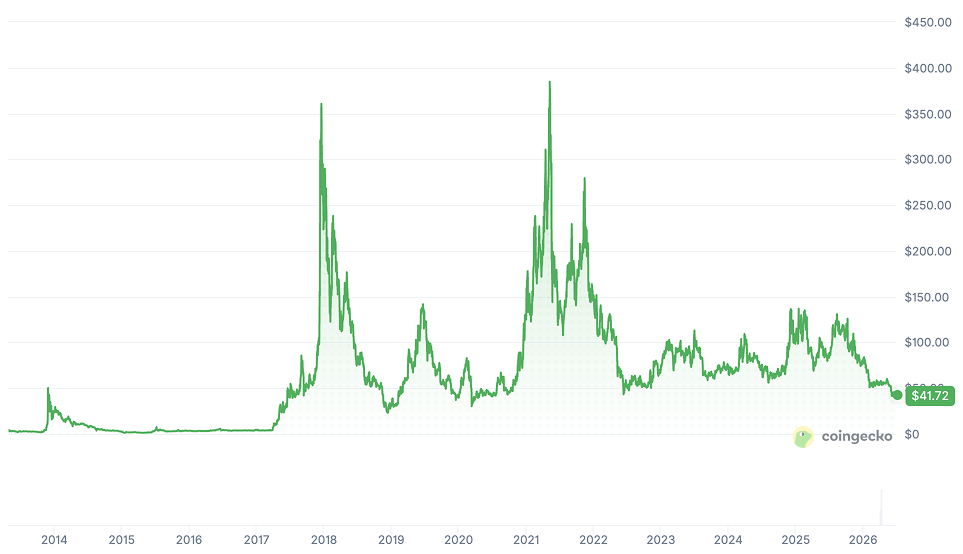
LTC Price Chart, CoinGecko, June 30, 2026
The biggest change this cycle is the launch of the Canary Litecoin ETF (LTCC). Although assets under management remain modest at around $5.5 million, the ETF gives institutions and retail brokerage clients regulated exposure to Litecoin for the first time.
Bitcoin still has the strongest influence on LTC, but that relationship is slowly evolving. ETF inflows create an additional source of demand that is independent of crypto exchanges, reducing Litecoin’s reliance on retail traders alone. As a result, any Litecoin price prediction for 2026 should consider both Bitcoin’s market cycle and the pace of institutional adoption, rather than focusing only on speculative momentum.
Technical Analysis: Support, Resistance, and On-Chain Metrics
Investing.com’s monthly technical data shows a weak short-term setup for Litecoin. The summary reads Strong Sell, with 12 moving averages and 8 technical indicators giving sell signals. RSI stands at 35.01, which shows weak momentum, while Stochastic, StochRSI, and Williams %R all sit in oversold territory. This means sellers still control the trend, yet a relief bounce can appear if buyers defend key levels.
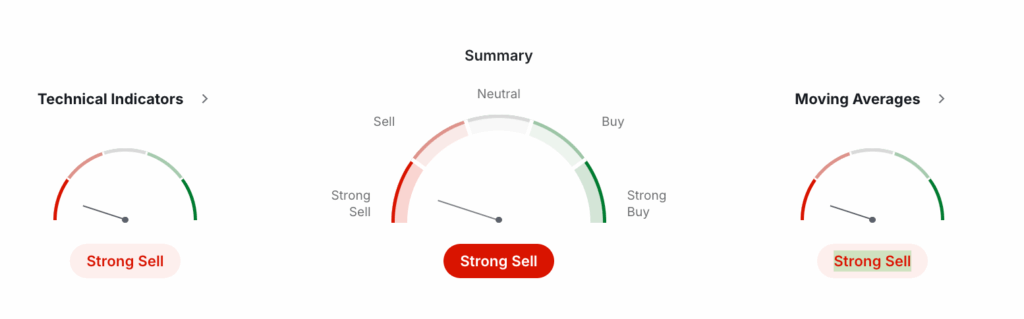
Investing, June 30, 2026
The main support zone sits near $48.07, followed by $44.1 and $37.85. If LTC loses these levels, the chart may stay under pressure. On the upside, resistance appears near $58.3, then $64.54 and $68.52. A clean move above these areas would improve the structure and make future Litecoin price predictions more constructive.
On-chain data gives a more balanced picture. BitInfoCharts shows 254,932 active Litecoin addresses in the last 24 hours, compared with 237,064 active addresses reported in February 2026, which suggests roughly 7.5% growth in active wallet activity despite weak price action.
Network usage also remains solid. BitInfoCharts reports 180,915 transactions in the last 24 hours, an average fee of only $0.0023, a median fee of $0.00038, and an average block time of 2 minutes 32 seconds. These figures support Litecoin’s payment-focused use case because users can still move value quickly and cheaply.
Security metrics are strong, but they need monitoring. BitInfoCharts places Litecoin hashrate near 2.53 PH/s, while CoinWarz shows the hashrate down 10.65% over 7 days and 14.22% over 30 days. That does not break the network thesis, but it shows that miner participation has cooled with the price.
The Post-ETF Reality: Wall Street’s Impact on LTC
The launch of the Canary Litecoin ETF (LTCC) marked a major turning point for Litecoin. LTCC began trading on Nasdaq in late October 2025 and became the first U.S. spot Litecoin ETF, giving investors exposure to LTC through a familiar brokerage product instead of a crypto exchange or private wallet. Canary’s own fund page lists Nasdaq as the exchange, an inception date of October 27, 2025, a 0.95% sponsor fee, and about $5.49 million in net assets as of June 29, 2026.
The approval path matters because LTCC did not appear in isolation. In September 2025, the SEC approved generic listing standards for commodity-based trust shares, including products that hold crypto asset commodities. Reuters reported that this change removed much of the old case-by-case review process and helped Canary launch Litecoin and Hedera products despite the SEC shutdown.
This gave the LTC ETF story more credibility. It also encouraged competition. Grayscale filed to convert its Grayscale Litecoin Trust into the Grayscale Litecoin Trust ETF, with NYSE Arca submitting a 19b-4 application in January 2025. That filing showed that major asset managers saw regulated Litecoin exposure as a serious product category, not just a short-term trade.
How Institutional Inflows Create a Supply Shock
A Litecoin spot ETF can create supply pressure because it must hold real LTC, not a paper claim. Canary’s holdings table showed 126,837.52 LTC held by LTCC on June 29, 2026. Compared with Litecoin’s circulating supply of about 77.33 million LTC, that equals roughly 0.16% of the market, so the current supply shock remains small.
The mechanism still matters. When ETF demand grows, authorized participants create new shares, the fund buys more LTC, and those coins move into custody. That can reduce liquid supply on exchanges and make price moves sharper during strong demand periods.
However, Litecoin is still far behind Bitcoin. U.S. spot Bitcoin ETFs recorded about $1.5 billion in net inflows in January 2024 alone, while LTCC sits near $5.49 million in net assets. This means Litecoin has the ETF structure, but not yet the Bitcoin-level flow engine.
Is Litecoin a Good Investment in 2026? Risk vs. Reward
So, is LTC a good investment in 2026? The answer depends on what you expect from it. Litecoin is not a high-growth smart contract platform like Solana, Ethereum, or newer Layer-1 networks. Instead, it is a liquid, battle-tested payment coin with deep exchange support, low fees, and a simple value proposition.
The bullish case is clear. Litecoin still has strong liquidity – LTC is near $3.2 billion in market cap and over $200 million in volume. BitPay’s 2025 report also shows LTC among the top five coins by payment volume and Litecoin as the fourth-largest payment network on its platform, which supports its real-world use case.
The risk is also real. Motley Fool argues that Litecoin faces pressure from Bitcoin’s Lightning Network and faster Layer-1 blockchains, while Cryptomus takes a more optimistic view and points to user growth, regular updates, and clearer regulation as potential support for LTC.
For beginners, Litecoin may work best as a smaller portfolio position, not a core holding. It offers stability and payment utility, but it needs stronger demand to outperform newer crypto networks.
Long-Term Network Outlook: The Scalability Roadmap
For investors asking whether Litecoin will go up, the stronger question is whether the network can stay useful. Litecoin’s roadmap focuses on practical payments, low fees, and optional privacy, not complex app ecosystems.
The key upgrade is MWEB, or MimbleWimble Extension Blocks. Litecoin activated MWEB in May 2022, and it lets users move LTC into a separate transaction layer where amounts can stay confidential. This gives Litecoin a privacy feature while keeping it optional for users and exchanges.
SegWit also matters. Litecoin activated SegWit in May 2017, which improved transaction efficiency and helped the network handle payments more smoothly.
Most importantly, Litecoin still keeps costs extremely low. BitInfoCharts recently showed an average Litecoin transaction fee near $0.0021–$0.0024, which supports its role as a fast payment network rather than a high-fee settlement chain.
The Role of Halving Cycles in Future Scarcity
Litecoin has a fixed supply cap of 84 million LTC, so its monetary policy becomes tighter over time. The block reward fell from 50 LTC to 25 LTC in 2015, then to 12.5 LTC in 2019, and to 6.25 LTC in 2023. The next halving should cut it to 3.125 LTC around 2027.
This scarcity does not guarantee instant gains. After past halvings, LTC often entered accumulation phases before stronger rallies appeared. That is why any Litecoin 2030 price prediction should focus on supply, demand, payments, and ETF adoption together, not on the halving alone.
How to Buy Litecoin on StealthEX
Buying Litecoin on StealthEX is straightforward because the platform works as a non-custodial crypto swap service. You do not need to create an account, complete registration, or leave funds on the platform. Instead, LTC goes directly to your personal wallet after the exchange.
- Select the trading pair you want to use, such as USDT to LTC, BTC to LTC, or ETH to LTC. Then enter the amount you want to exchange and review the estimated rate before continuing.
- Paste your personal Litecoin wallet address. This step matters because StealthEX does not hold your LTC in a user account. You keep control through self-custody and private key ownership.
- Confirm the transaction and send the deposit from your own wallet. StealthEX shows the exchange details before you start, so there are no hidden fund management fees or ongoing custody charges after the swap.
Litecoin Investment Access Methods
| Investment Vehicle Type | Management Fees (AUM) | Trading Structure | Custody Verification Method |
| US Spot Litecoin ETF (LTCC) | 0.95% Annual Sponsor Fee | Trades on Nasdaq (Intraday Liquidity) | Regulated Third-Party (Coinbase Custody / BitGo) |
| Legacy Over-The-Counter Trusts | Variable (Often 2.0%+) | Trades OTC (Risk of NAV Premium/Discount) | Internal Trust Vaults |
| Direct LTC Holdings via StealthEX | 0% Management Fees | Instant Non-Custodial Swap | True Self-Custody (Private Key Ownership) |
Conclusion: Navigating the Litecoin Market in 2026
Litecoin enters 2026 with a rare mix of history, liquidity, and new institutional access. Its network remains stable, its fees stay low, and the LTCC ETF gives traditional investors a regulated path to LTC exposure. Payment adoption also supports its real-world use case, especially for fast and low-cost transfers. Still, Litecoin faces strong competition from newer blockchains, so the question of whether I should invest in Litecoin depends on risk tolerance. For most beginners, LTC may fit best as a smaller, diversified crypto position rather than an all-in bet.
Frequently Asked Questions About Litecoin Investment and ETFs
What Is a US Spot Litecoin ETF and How Does It Differ From Existing Crypto Trusts?
A spot ETF holds actual LTC and trades intraday on a regular exchange. Grayscale’s Litecoin Trust gives LTC exposure too, but OTC trusts can trade with premiums or discounts. Spot ETFs usually track LTC more cleanly.
Will Litecoin Reach $1000?
At $1,000, Litecoin would need a market cap near $77 billion based on its current circulating supply. That would likely require major ETF inflows, a broad crypto bull market, and stronger payment adoption. Probability before 2030: low.
Does Litecoin Have a Future Beyond 2026?
Yes, Litecoin has a future if users keep valuing fast, cheap payments. Its strengths are uptime, liquidity, and near-zero-cost transfers, but it must compete with newer Layer-1s and Bitcoin payment rails.
Why Is Litecoin Going Up in 2026?
When Litecoin rises, key drivers include ETF demand, Bitcoin rally spillover, adoption news, and technical breakouts from oversold levels. LTC still follows Bitcoin often, but ETF access can add independent demand.
How Can I Use Dollar-Cost Averaging to Invest in Litecoin?
Dollar-cost averaging means buying a fixed amount on a schedule, such as $50 weekly. If LTC trades near $50, four weekly buys equal about 4 LTC monthly. This reduces timing risk and emotional decisions.
Make sure to follow StealthEX on Medium, X, Telegram, YouTube, and Publish0x to stay updated about the latest news on StealthEX and the rest of the crypto world.
Don’t forget to do your own research before buying any crypto. The views and opinions expressed in this article are solely those of the author.
crypto price prediction cryptocurrency Litecoin LTC price analysisThe post Litecoin Price Analysis & ETF Outlook for 2026 first appeared on StealthEX.]]>
What Is the Quantum Financial System?
The quantum financial system refers to a theoretical concept that suggests using quantum computing for faster and more secure financial transactions. Supporters often describe it as a next-generation system that could transform global finance.
This idea emerged from online discussions that combine real quantum research with unverified claims. As a result, many explanations mix facts with speculation.
The internet version often presents unrealistic promises. In contrast, real quantum finance focuses on research and gradual development. Importantly, no operational QFS exists today.
Quantum Computing Technology in Finance
Quantum computing in finance uses qubits instead of classical bits. Qubits can exist in multiple states at once due to superposition and entanglement. This allows complex calculations that traditional systems struggle to perform.
Major companies like IBM, Google, and IonQ develop quantum hardware and software. At the same time, banks such as JPMorgan Chase and Goldman Sachs test algorithms for pricing, risk analysis, and portfolio optimization.
However, the technology still has strong limitations. Error rates remain high, and decoherence disrupts calculations. We currently operate in the NISQ era, which means systems remain powerful but not yet scalable.
QFS and Cryptocurrency: The Connection
The quantum financial system crypto discussion appears often because both ideas aim to improve financial systems. They also rely on advanced cryptography and challenge traditional banking models.
However, current cryptocurrencies run on classical computers, not quantum machines. Bitcoin and other networks depend on existing encryption standards.
Quantum computing could threaten this encryption in the future. Because of that, developers already explore quantum-resistant algorithms. Meanwhile, platforms like StealthEX allow users to swap digital assets instantly, without relying on quantum infrastructure.
QFS Implementation: Myths vs Reality
Many people ask, is the quantum financial system real, especially after reading online claims. Some say it already works, cancels global debt, or operates under hidden control.
In reality, no evidence supports these claims. Quantum finance remains in research labs and experimental environments. It requires massive infrastructure and long-term development before real-world use.
These myths remain popular because people distrust institutions and misunderstand complex technologies. As a result, simple narratives spread faster than technical facts.
| Feature / Claim | QFS Conspiracy Myth | Quantum Finance Reality (2026) |
| Current Status | Fully operational and hidden. | Experimental / Research stage (NISQ era). |
| Control | Controlled by secret military/groups. | Developed by IBM, Google, JPMorgan Chase, and universities. |
| Debt Forgiveness | “Global Currency Reset” will erase debt. | No such mechanism; focus on algorithm optimization. |
| Infrastructure | Satellite-based “unhackable” network. | Fiber-optic Quantum Key Distribution (QKD) in labs. |
Current Status of Quantum Financial Technology
Quantum finance already exists, but only in research environments. Projects like IBM Q Network and quantum teams at JPMorgan Chase explore new algorithms. Goldman Sachs also works with QC Ware on simulations.
These teams focus on derivative pricing and portfolio optimization. Most work stays at proof-of-concept stage. No production systems exist yet. Experts estimate that practical adoption may take 15 to 30 years.
| Use Case | Description | Primary Benefit | Leading Firms (2026) |
| Portfolio Optimization | Selecting the best assets using quantum algorithms. | Faster processing of complex variables. | JPMorgan Chase, HSBC, Goldman Sachs |
| Derivative Pricing | Simulating market scenarios (Monte Carlo). | Higher accuracy in risk assessment. | QC Ware, IBM, IonQ |
| Fraud Detection | Quantum-enhanced machine learning. | Real-time identification of suspicious patterns. | Mastercard, Barclays |
Quantum Threats to Current Cryptocurrency Security
Many ask what is QFS in crypto, especially when discussing future risks. A key concept is “Q-day,” when quantum computers could break current encryption.
Algorithms like Shor’s could target Bitcoin and Ethereum security. This risk may emerge in the 2030s, based on current projections.
To prepare, developers build post-quantum cryptography. The crypto industry, including platforms like StealthEX, monitors these threats closely.
| Cryptographic Standard | Current Use (Examples) | Quantum Threat Level | Defense Strategy (2026) |
| ECDSA / RSA | Bitcoin, Ethereum, SSL/TLS | Critical (broken by Shor’s algorithm) | Transition to Post-Quantum Cryptography (PQC). |
| AES-256 | Data encryption, file storage | Low (Grover’s algorithm requires larger keys) | Increase key sizes to maintain security. |
| Hashing (SHA-256) | Bitcoin mining / Proof of Work | Low (quantum resistant) | No immediate change needed for mining. |
The Role of Crypto Exchanges in Future Financial Systems
The QFS system discussion often includes crypto exchanges. These platforms act as bridges between current and future financial technologies.
Services like StealthEX allow instant swaps without KYC. This flexibility helps users adapt as technology evolves.
Exchanges also track quantum-resistant protocols and improve security. If you want fast and secure swaps today, platforms like StealthEX offer a practical solution.
Investment Implications and Considerations
When exploring QFS stock ideas, caution remains essential. Many scams promise profits from fake “QFS accounts” or special currencies. These offers lack legitimacy.
Real opportunities include companies like IBM, Google, and IonQ, as well as quantum-focused ETFs.
Always verify sources, check regulations, and consult experts. Focus on secure crypto trading instead of speculative schemes.
When Will the Quantum Financial System Start?
The official launch date of the global Quantum Financial System has not yet been set, and no government or central bank has confirmed plans to implement it. Although major financial institutions are testing quantum computing to solve highly specialized problems, a fully-fledged quantum monetary system remains highly speculative and currently exists only as a concept.
The Future of Quantum Financial Systems
The new quantum financial system will likely evolve over time, not appear suddenly. In the next 5–10 years, more pilot programs will emerge.
In 10–20 years, quantum advantage may improve financial modeling and security. Post-quantum cryptography could become standard.
Beyond 20 years, quantum systems may support specific financial functions. However, change will remain gradual, not revolutionary.
Common Questions About Quantum Financial Systems
What Does QFS Stand for In the Financial Industry?
The keyword what does QFS mean often appears online. QFS stands for “Quantum Financial System” in discussions and theories. However, this is not an official industry term. Financial professionals use “quantum computing in finance,” not QFS, in real-world contexts.
What Is the QFS Ledger and How Does It Work?
The QFS ledger is often described as a quantum-encrypted distributed system. This idea mixes blockchain concepts with unverified features. Real ledgers, like blockchain, rely on cryptographic hashing. No working quantum ledger like this exists today.
Will the QFS Introduce a New Digital Currency?
The idea of a QFS digital currency often includes gold-backed tokens. However, this claim lacks evidence. In reality, central banks develop CBDCs, and cryptocurrencies already operate independently. Platforms like StealthEX offer existing digital assets today.
How Do QFS Assets and Asset Management Work?
The term QFS assets usually appears in misleading claims. These claims often link to scams. In reality, quantum finance supports portfolio optimization and risk analysis. Firms like JPMorgan Chase research these tools, but they do not create new asset classes.
What Is the Role of the QFS Network in Global Finance?
There is no real QFS network in global finance. Some claim it replaces existing systems, but no proof exists. Research focuses on quantum communication, such as secure key distribution. Current systems still rely on SWIFT, ACH, and blockchain networks.
Follow us on Medium, X, Telegram, YouTube, and Publish0x to stay updated about the latest news on StealthEX.io and the rest of the crypto world.
Don’t forget to do your own research before buying any crypto. The views and opinions expressed in this article are solely those of the author.
AI and Crypto blockchain technology cryptocurrency QFS Quantum Financial SystemThe post QFS: Complete Guide to the Quantum Financial System first appeared on StealthEX.]]>
Understanding the Federal Reserve and Interest Rates
The Federal Reserve, or Fed, is the central bank of the United States. It matters to crypto because it controls the cost of money in the world’s largest economy. The Fed has two goals: keep inflation near 2% and support maximum employment. When inflation stays high, the Fed keeps rates higher. When growth weakens, it may cut rates to support borrowing and investment.
The key policy group is the Federal Open Market Committee, or FOMC. For beginners, the FOMC meaning crypto is simple: this group decides whether money becomes easier or harder to access. That decision can change liquidity, investor confidence, and demand for Bitcoin and altcoins.
In 2025, the Fed cut rates three times and moved the federal funds rate to 3.50–3.75%. In 2026, sticky inflation pushed the Fed into a hawkish hold. The March dot plot signaled only one more cut for the year, so the Fed’s tone now matters as much as the rate decision itself.
What Is the Federal Reserve?
The Federal Reserve is the central banking system of the United States, created in 1913. It includes the Board of Governors and 12 regional Federal Reserve Banks. Its main job is to support price stability and maximum employment. In 2026, the Fed must lower inflation toward 2% without pushing the economy into recession.
How the Fed Sets Interest Rates
The Fed sets policy through the FOMC, which meets eight times per year. Members review inflation, jobs, growth, and financial conditions, then vote on the federal funds rate. The decision comes at 2:00 PM ET. In 2026, January and March both ended with a 3.50–3.75% hold. Powell has stressed data dependence and no urgency to cut. In crypto, FOMC signals can move liquidity, risk appetite, and Bitcoin demand.
The Direct Connection Between Interest Rates and Crypto Markets
Interest rates reach the crypto market through four main channels: risk appetite, dollar strength, liquidity, and opportunity cost. Together, they explain why the Federal Reserve can move Bitcoin and altcoins even when it never mentions crypto directly.
When the Fed lowers rates, investors often become more willing to buy assets with higher upside. That can support Bitcoin, Ethereum, and smaller altcoins. However, when rates stay high, many investors prefer cash, bonds, or defensive stocks because those assets look safer.
The dollar adds another layer to this relationship. Since most cryptocurrencies trade against USD, a stronger dollar often makes crypto less attractive for global investors. At the same time, tighter liquidity leaves less money available for speculative markets.
High rates also change the way investors compare Bitcoin with traditional assets. Bitcoin does not pay interest, while cash and short-term bonds can offer real yield when rates remain elevated. For that reason, some investors reduce crypto exposure until the Fed sounds more dovish.
This is why the Fed cryptocurrency relationship is not as simple as “rates down, crypto up.” In 2025, Bitcoin rose after only 1 of 8 FOMC meetings, even though the Fed had started cutting rates.
For traders, the real signal often comes from the Fed’s tone. Sticky inflation, cautious language, and pause signals can pressure crypto even after a rate cut. That is why FOMC Bitcoin reactions depend on context, not only the headline decision.
Risk Appetite and the Risk-On/Risk-Off Dynamic
Markets often move between risk-on and risk-off conditions. In a risk-on market, investors look for growth and upside. Crypto usually benefits because traders feel more comfortable holding volatile assets.
In a risk-off market, investors protect capital first. They often move money into cash, bonds, or large defensive stocks. Crypto can fall quickly in this environment because it still trades like a high-risk asset.
In 2026, the Fed’s hawkish pause pushed the market toward caution. Bitcoin fell from its October 2025 peak near $126K to about $60K by June 2026, while many institutions reduced exposure to volatile assets.
The Dollar Strength Factor
Higher U.S. interest rates can keep the dollar strong because investors can earn better returns in USD assets. That creates pressure for Bitcoin and altcoins because crypto markets still use the dollar as their main pricing benchmark.
When the dollar rises, global buyers often need more local currency to buy the same amount of Bitcoin. This can weaken demand, especially during periods when investors already feel cautious.
During strong market trends, BTC and DXY often move in opposite directions. Correlation can range from around -0.6 to -0.8, which means a stronger dollar often appears together with a weaker Bitcoin price action.
Historical Analysis: How Bitcoin Responded to Past Fed Decisions
Bitcoin has reacted to Fed policy in clear cycles, but each cycle had its own story. In 2020 and 2021, near-zero rates and quantitative easing pushed more money into risk assets. Bitcoin moved from about $7K in early 2020 to nearly $69K in November 2021.
The next phase looked very different. From March 2022 to July 2023, the Fed raised rates from 0–0.25% to 5.25–5.50%. Bitcoin opened 2022 near $47K and later fell to about $15.5K in November 2022.
Then came the pivot. The Fed made its first cut in September 2024, followed by three more cuts in 2025. ETF demand and easier policy helped Bitcoin reach a new high near $126K in October 2025, although later Fed signals cooled the rally.
| Fed Rate Cycle | Period | Rate Range | BTC Price Start | BTC Price End | BTC Change |
| Zero Rate Policy + QE | Mar 2020 – Mar 2022 | 0–0.25% | $7,000 | $69,000 | +886% |
| Aggressive Hike Cycle | Mar 2022 – Jul 2023 | 0.25% → 5.50% | $47,000 | $15,500 | −67% |
| Pivot & Cut Cycle | Sep 2024 – Dec 2025 | 5.50% → 3.50–3.75% | $54,000 | $94,000* | +74% |
| Hawkish Pause | Jan 2026 – present | 3.50–3.75% (hold) | $94,000 | ~$60,000 | −36% |
Rate Hike Cycles and Crypto Performance (2022–2023)
The 2022–2023 hiking cycle gave crypto investors a harsh lesson. The Fed raised rates 11 times, moving from 0–0.25% to 5.25–5.5%. Bitcoin opened 2022 near $47K, then bottomed near $15.5K in November 2022, a drop of roughly 67%. The damage did not come from one meeting. It came from months of tighter money, weaker confidence, and falling risk appetite.
Rate Cut Cycle and the 2024–2025 Bull Run
The Fed began cutting in September 2024 after a long pause. In 2025, it cut again in September, October, and December, bringing rates down to 3.5–3.75%. Bitcoin reached a new high near $126,080 in October 2025 as ETF buying added fuel to the move. Yet the rally did not last smoothly. After the December cut, BTC slipped from its $94K peak as traders focused on the hawkish dot plot.
What Fed Rate Cuts Mean for Crypto Investors in 2026
For crypto investors, 2026 is not just about whether the Fed cuts rates. The bigger question is why it cuts, how fast it moves, and whether inflation finally cools.
As of June 2026, the federal funds rate sits at 3.50–3.75%. The March dot plot pointed to only one possible cut before year-end, while inflation remained above the Fed’s 2% target.
Bitcoin also entered this period under pressure. After reaching a peak near $126K in October 2025, BTC traded around $60K–$64K in June 2026. This shows how quickly macro sentiment can change.
| Scenario | Fed Action | Fed Funds Rate by End 2026 | BTC Price Range | Key Trigger |
| Base Case | 1 cut of 0.25% in Q3/Q4 | 3.25–3.5% | $70,000–$90,000 | Inflation gradually declining toward target |
| Optimistic | 2 cuts, soft landing | 3–3.25% | $100,000–$120,000 | CPI drops below 2.5%, labor market stable |
| Pessimistic | No cuts, extended pause | 3.5–3.75% | $45,000–$60,000 | Inflation re-accelerates, stagflation risk |
Current Economic Context (2026)
The 2026 setup remains difficult for risk assets. The Fed has kept rates at 3.5–3.75% since the final 2025 cut, while inflation still sits above target.
The March 2026 dot plot showed only one projected cut through year-end. At the same time, Bitcoin traded far below its $126K peak, and ETF outflows after the March FOMC meeting showed that institutions were still cautious.
This is why Fed news today FOMC crypto impact matters so much. Markets are no longer pricing in easy money as a certainty.
Rate Cut Scenarios for the Rest of 2026
The base case is one 0.25% cut in Q3 or Q4. If inflation keeps improving, Bitcoin could recover toward $80K–$90K as liquidity conditions slowly loosen.
The optimistic case requires faster inflation progress and a soft landing. In that setup, two cuts could bring stronger ETF demand and push BTC toward $100K–$120K.
The pessimistic case is simple: inflation stays high, and the Fed holds rates for longer. That could keep Bitcoin in a wide $55K–$70K range, with weaker altcoins facing even more pressure.
Trading Strategies Around FOMC Announcements
A FOMC meeting crypto setup needs a plan before the news hits. In 2025, Bitcoin rallied after only 1 of 8 FOMC meetings, so traders should not assume that every rate cut or dovish headline will lift the market.
The most volatile period usually starts 48 hours before the decision and lasts through Powell’s press conference. Short-term traders often chase the first move, but the second move can matter more because Powell may confirm or reverse the market’s first reaction.
Long-term investors can use FOMC events to rebalance, not panic. Short-term traders need stricter rules, clear stop-loss levels, and alerts near major support zones. The goal is simple: protect capital first, then react when the Fed’s message becomes clear.
| Strategy Type | Pre-FOMC (48h Before) | Announcement (2:00 PM ET) | Press Conference (2:30 PM ET) | Risk Level |
| Conservative (HODLer) | Reduce position size by 20–30% | No action, wait for dust to settle | Re-enter if tone is clearly dovish | Low |
| Moderate (Swing trader) | Set tight stop-losses at key support | Watch for initial 2–5% move direction | Confirm trend before adding exposure | Medium |
| Aggressive (Short-term trader) | Position based on options implied vol | Trade the initial spike with strict SL | Fade the overreaction if divergence appears | High |
| Stablecoin strategy | Rotate part to USDT/USDC via StealthEX | Hold stablecoins through volatility | Redeploy into BTC/ETH after clarity | Low–Medium |
Pre-FOMC Meeting Positioning
Before a major Fed meeting, Bitcoin often becomes harder to trade cleanly. Implied volatility can rise during the week before the announcement, while spot price may move sideways in a tight range during the final 24 hours.
This is one reason behind searches like why crypto selling off before FOMC announcement. Traders reduce risk before uncertain news, and leveraged positions can unwind quickly. Conservative investors may lower exposure, while aggressive traders should keep stop-losses tight.
In March 2026, a hawkish press conference pushed BTC down about 5% and triggered $708 million in ETF outflows.
Reacting to Fed Decisions
The first reaction usually comes at 2:00 PM ET, when the Fed releases its decision. Bitcoin can move 2–5% within minutes, especially when traders did not fully price in the outcome.
The second test comes at 2:30 PM ET, during press conference. Hawkish phrases such as “inflation remains elevated” or “no rush to cut” can pressure crypto. Dovish language can support risk appetite.
In 2026, the March hold plus hawkish tone sent BTC lower. Before every Fed meeting crypto event, traders should mark key support levels and set alerts in advance.
Using StealthEX for Strategic Exchanges During Fed Volatility
During Fed-driven volatility, speed can matter. StealthEX.io allows users to rebalance a crypto portfolio without registration or long KYC delays. A trader can swap altcoins into Bitcoin when hawkish Fed signals look likely, or move part of a portfolio into USDT or USDC during uncertainty. The platform is non-custodial, and its fixed-rate option can help lock in prices during fast FOMC price swings.
Warning Signs and Indicators to Monitor in 2026
Crypto investors should track the same signals the Fed watches. In 2026, sticky inflation remains the main risk because it can keep rates high for longer and delay the next cut.
The most important reports are CPI, PCE, and NFP. CPI shows consumer inflation, PCE gives the Fed its preferred inflation view, and NFP shows whether the labor market remains too strong for quick easing.
Fed communication also matters. The dot plot, meeting minutes, and FOMC speeches can change expectations before any official decision. For crypto, ETF flows, funding rates, and open interest show whether institutions and leveraged traders are adding risk or cutting exposure.
| Indicator | Release Schedule | Bullish Signal for Crypto | Bearish Signal for Crypto |
| CPI (Consumer Price Index) | Monthly | Below expectations, inflation cooling | Above expectations, inflation sticky |
| PCE (Personal Consumption Expenditures) | Monthly | Declining trend toward 2% target | Persistently above 2.5% |
| NFP (Non-Farm Payrolls) | First Friday of month | Weak jobs data, more room to cut | Very strong jobs, no urgency to cut |
| FOMC Dot Plot | 4x per year, quarterly meetings | More cuts projected than expected | Fewer cuts or extended hold |
| BTC Spot ETF Flows | Daily | Net inflows, institutional buying | Net outflows, institutional risk-off |
| Fed Chair Press Conference | After each FOMC meeting | Dovish tone, open to cutting | Hawkish tone, “no rush to cut” |
Key Economic Data Releases
CPI, PCE, and NFP can move Bitcoin because they shape the Fed’s next decision. When inflation comes in above expectations, traders often expect tighter policy, and BTC can drop 3–5% in a fast reaction.
Weak labor data can have the opposite effect. It may give the Fed more room to cut rates, which can support risk assets. In 2026, investors should watch for steady progress toward the Fed’s 2% inflation target, as this could become a major rally catalyst.
Fed Officials’ Speeches and Forward Guidance
Fed officials can move markets before they change rates. Traders listen closely to the Fed Chair, voting FOMC members, and regional Fed presidents because their words shape rate expectations.
A hawkish tone points to caution, sticky inflation, and no urgency to cut. A dovish tone suggests more concern about growth and more openness to easing. In 2026, the dot plot remains the main anchor, especially after March signaled only one cut through year-end.
Common Misconceptions About Fed Policy and Crypto
Many beginners think Fed policy works like a simple switch: cut rates, crypto goes up; raise rates, crypto goes down. The real market works with more nuance.
The first myth is that rate cuts always drive crypto higher. In 2025, Bitcoin rose after only 1 of 8 FOMC meetings, even though the Fed had started cutting. The market cared more about inflation, future guidance, and Powell’s tone.
The second myth is that crypto is separate from traditional finance. That idea became weaker as spot ETFs brought more institutions into Bitcoin. As large funds entered the market, BTC started reacting more like a macro risk asset.
The third myth is that only the Fed matters. The Fed is important, but global liquidity also depends on the ECB, the Bank of Japan, and worldwide M2 money supply. Crypto trades globally, so investors should track more than one central bank.
Rate Cuts Always Mean Crypto Pumps
Rate cuts can help crypto, but the reason behind the cut matters. Preventative cuts during a stable economy can support Bitcoin because liquidity improves and risk appetite returns.
Emergency cuts can work differently. If the Fed cuts because a crisis is building, investors may sell crypto first and move into safer assets.
That happened in 2025–2026. The Fed delivered three cuts, yet BTC stayed below its $126K high and later fell sharply as sticky inflation and the hawkish pause damaged sentiment.
Crypto Is Independent of Traditional Finance
Crypto once looked more detached from stocks, but institutional adoption changed that. As Bitcoin ETFs grew, many of the same investors started allocating capital across BTC, equities, and other risk assets.
BTC/S&P 500 correlation has climbed from roughly 0.1–0.2 in earlier periods to around 0.6–0.8 during stronger macro-driven phases. That means Bitcoin often reacts to the same catalysts as tech stocks.
The $708 million ETF outflow after the March 2026 FOMC meeting confirmed this shift. Crypto now responds to Fed signals, risk appetite, and institutional positioning.
Frequently Asked Questions
What Happens to Bitcoin When the Fed Cuts Rates?
Bitcoin often benefits when the Fed cuts rates because liquidity improves and the dollar may weaken. However, the reaction depends on context. In 2025, BTC rose after only 1 of 8 FOMC meetings, so the Fed’s tone matters more than the cut itself.
What Is FOMC in Crypto?
FOMC stands for Federal Open Market Committee. It is the Fed group that sets interest rate policy. In crypto, FOMC decisions affect liquidity, risk appetite, and dollar strength, which can quickly move Bitcoin and altcoin prices.
How Does Fed Policy Affect Cryptocurrency Prices?
Fed policy affects crypto through interest rates, liquidity, the U.S. dollar, and investor risk appetite. Lower rates can support Bitcoin, while higher or held rates can pressure crypto. In 2026, a hawkish Fed helped push BTC far below its 2025 peak.
Follow us on Medium, X, Telegram, YouTube, and Publish0x to stay updated about the latest news on StealthEX.io and the rest of the crypto world.
Don’t forget to do your own research before buying any crypto. The views and opinions expressed in this article are solely those of the author.
altcoins Bitcoin Bitcoin BTC BTC price analysisThe post Fed Rate Cuts & Crypto: How Interest Rates Affect Bitcoin and Altcoins in 2026 first appeared on StealthEX.]]>
What Are Play2Earn (P2E) Crypto Games?
P2E crypto games are blockchain-based games where players earn cryptocurrency or NFTs through gameplay instead of only spending money. In traditional games, you pay to play. However, in this model, you can earn while you play. Players complete tasks, win battles, or trade assets, and in return they receive tokens with real value. This shift changes gaming from entertainment into a potential income source.
How Do Play-to-Earn Games Work?
PlayToEarn games connect gameplay actions with real financial rewards through blockchain systems. Players earn tokens or NFTs by completing in-game tasks, and each reward has market value.
The process is simple: you play, you earn assets, and then you can sell or exchange them. Because tokens trade on crypto markets, players can convert in-game earnings into real money, which creates a direct link between time spent and potential income.
Game Mechanics and Earning Methods
In crypto earning games, players generate rewards through multiple activities. You can complete quests, win battles, or rank high in competitions to receive tokens.
Some games allow staking, where you lock tokens to earn passive rewards. Others focus on NFTs, so you can breed characters, upgrade items, and sell them on marketplaces.
Tournaments often offer higher payouts, while advanced users rent assets to other players and earn a share of their profits.
Converting In-Game Earnings to Real Money
In crypto games that pay, you must move your rewards outside the game to access real value. First, you transfer tokens to your crypto wallet. Then, you sell them on exchanges or swap them into popular coins like BTC or ETH.
Services like StealthEX simplify this process because they allow fast, non-custodial swaps between tokens. After conversion, you can withdraw funds to fiat using a supported exchange or payment method.
Risks and Challenges of Play2Earn Gaming
Many beginners ask, are Play to Earn games legit, and the answer depends on the project. While some games offer real opportunities, P2E is not guaranteed income.
Earnings depend on market conditions, game design, and player demand. Token prices can change fast, and some projects fail to sustain their economy. In addition, scams and poorly built games still exist, so careful research always matters before investing time or money.
Market Volatility and Token Value Fluctuations
Token prices in P2E games often follow the broader crypto market, so they can rise quickly but also drop just as fast. When prices fall, player earnings lose value even if rewards stay the same.
For example, games like Axie Infinity saw strong growth, but later token declines reduced profitability. Because of this, income from P2E depends not only on gameplay but also on market timing and demand.
Scams and Security Concerns
Not all projects qualify as legit Play to Earn games, so players must stay alert. Some fake games promise high returns and then disappear in rug pulls. Others use phishing links to steal wallet access. Smart contract flaws can also lead to lost funds.
You should watch for red flags such as anonymous teams, no audits, and unrealistic profit claims, because these signals often indicate higher risk.
Best Play to Earn Games in 2026
The best Play to Earn games combine strong gameplay with stable economies and active communities. In this list, we focus on projects with proven earning models, reliable development teams, and consistent player activity. These factors help reduce risk and improve long-term potential, especially for beginners who want a safer entry into P2E gaming.
Top Play to Earn Crypto Games
The top Play to Earn crypto games include well-established titles with active ecosystems and real earning opportunities. Axie Infinity (AXS, SLP) runs on Ronin and requires an initial NFT purchase, usually around $50–$150. The Sandbox (SAND) on Ethereum focuses on virtual land and user-generated content, with entry depending on land or assets. Decentraland (MANA), also on Ethereum, offers similar metaverse experiences with variable costs. Gods Unchained (GODS) on Immutable X provides a free start with optional card purchases. Splinterlands (SPS) on Hive allows low-cost entry, often under $20, making it beginner-friendly.
| Game Name | Genre | Blockchain | Native Token | Entry Cost | Platform |
| Axie Infinity | Strategy / Battler | Ronin (ETH) | AXS / SLP | Low (Scholarships available) | PC, Android, iOS |
| The Sandbox | Metaverse | Ethereum | SAND | Land-dependent | PC, Mac |
| Decentraland | Virtual World | Ethereum | MANA | Free to enter | Web Browser |
| Gods Unchained | Trading Card Game | Immutable X | GODS | Free-to-Play | PC, Mobile |
| Splinterlands | Card Strategy | Hive | SPS / DEC | ~$10 (Spellbook) | Web, Mobile |
| Illuvium | RPG / Auto-battler | Ethereum | ILV | Medium | PC, Mac |
Best Play to Earn Mobile Games (Android & iOS)
Play to Earn mobile games allow users to earn directly from their phones, which makes them accessible and flexible. Axie Infinity offers a mobile version with full gameplay features. Thetan Arena combines MOBA-style action with token rewards for winning matches. Pegaxy focuses on racing and NFT horse breeding, with earning tied to performance. Coin Hunt World rewards players for exploring real-world locations. Arc8 by GAMEE offers casual mini-games with small but consistent rewards, which suits beginners who want simple entry.
| Game Title | Android Support | iOS Support | Play Store / App Store | Earning Potential |
| Thetan Arena | ✅ Yes | ✅ Yes | Direct Download / Stores | Moderate (Skill-based) |
| Coin Hunt World | ✅ Yes | ✅ Yes (TestFlight) | Play Store | Geo-location rewards |
| Arc8 by GAMEE | ✅ Yes | ✅ Yes | Official Stores | Casual / Tournament |
| Pegaxy | ✅ Yes | ✅ Yes | Web Browser / App | Passive (Rental) |
| Walken | ✅ Yes | ✅ Yes | Official Stores | Move-to-Earn |
Best Free Play to Earn Games (No Initial Investment)
Many free Play to Earn games allow users to start without upfront costs, which lowers the entry barrier. Gods Unchained offers free starter decks, so players can earn cards and tokens over time. Splinterlands provides a limited free version, although full earning requires upgrades. Coin Hunt World remains fully free, but rewards depend on activity and location. RollerCoin simulates mining, where players earn small rewards through mini-games. However, free players usually earn less than those who invest.
NFT Games Play to Earn
NFT games Play to Earn rely on ownership of digital assets that players can trade or use in gameplay. In RPG-style games, NFTs represent characters or items that grow in value as you progress. In metaverse platforms like The Sandbox or Decentraland, land NFTs generate income through renting or events. Card games such as Gods Unchained use NFTs for decks, which players can sell. Because players own these assets, they can profit both from gameplay and market demand.
Getting Started with Play2Earn Gaming
Starting with a Play to Earn game does not require advanced knowledge, but you should follow a clear process. First, learn how the game works and understand its economy. Then, begin with a small investment or choose a free option. This approach helps you reduce risk while gaining experience. Over time, you can scale your activity based on results and confidence.
Setting Up a Crypto Wallet
To join any P2E game, you need a crypto wallet to store tokens and NFTs. Popular options include MetaMask, Trust Wallet, and game-specific wallets like Ronin. First, download the wallet and create a new account. Then, write down your seed phrase and store it offline, because this is the only way to recover access. After that, set a strong password and enable extra security features if available.
Choosing Your First P2E Game
When selecting from the best P2E games, focus on simplicity and reliability. Choose a game that matches your interests, because this helps you stay consistent. It is safer to start with established projects that have active communities and proven systems. Avoid new games with unclear models. In addition, read guides, join Discord groups, and check player feedback before making any decision.
Maximizing Earnings in P2E Crypto Games
To earn more from a P2E game, you need both strategy and consistency. Casual play may generate small rewards, but structured gameplay improves results. Players who track performance, manage assets, and follow market trends often achieve better outcomes. Over time, experience helps you identify what works and where to focus your effort.
Most Profitable Play to Earn Strategies
In the most profitable Play to Earn games, success depends on efficiency. Focus on activities that offer the highest rewards for your time, such as ranked battles or high-value missions. Build a daily routine to maximize consistency. You can also trade NFTs by buying undervalued assets and selling them later. Some players join scholarship programs, where they use rented assets and share profits, which reduces upfront costs.
How to Exchange Play2Earn Tokens with StealthEX
When you earn rewards from a Play to Earn crypto game, you often need to convert them into more widely used cryptocurrencies. StealthEX offers a simple solution because it allows fast, non-custodial swaps without account creation. You keep full control over your funds, which improves security. In addition, the platform supports hundreds of assets, including popular gaming tokens, so you can easily manage and exchange your earnings.
Step-by-Step Guide to Exchanging Gaming Tokens
- To exchange your gaming rewards, go to StealthEX.io and select the token you want to swap.
- Enter the amount and choose the cryptocurrency you want to receive, such as BTC or ETH. Then, provide your wallet address where the funds will arrive.
- After that, send your tokens to the generated address. Once the transaction confirms, you will receive the exchanged crypto.
Always double-check wallet details and network compatibility before sending funds to avoid mistakes.
Supported Play to Earn Cryptocurrencies
The platform supports a wide Play to Earn crypto games list, which includes major gaming tokens used across popular titles. You can swap assets such as:
These tokens come from leading ecosystems and have active markets. StealthEX also adds new gaming assets, so support continues to expand as the P2E sector grows.
| Gaming Token | Project | Network | Popular Swap Pairs | Why Swap on StealthEX? |
| AXS | Axie Infinity | Ethereum | AXS to ETH / USDT | Non-custodial, No limit |
| SAND | The Sandbox | Ethereum | SAND to BTC / ETH | Fast processing |
| MANA | Decentraland | Ethereum | MANA to SOL / MATIC | Secure & Anonymous |
| GODS | Gods Unchained | Immutable X | GODS to ETH | Best rates for gamers |
| GALA | Gala Games | Ethereum / Gala | GALA to USDT | Easy exit to fiat-ready coins |
Frequently Asked Questions
What Are the Best Crypto Games to Make Money in 2026?
The best crypto games to make money in 2026 include Gods Unchained, The Sandbox, and Splinterlands. These games offer active communities, stable economies, and proven reward systems. They also balance gameplay and earning potential, which helps players generate more consistent results over time.
Can You Really Make Money with Play To Earn Games?
Yes, crypto games to make money can generate income, but results vary. Earnings depend on time, skill, and market conditions. Some players earn consistently, while others see small returns. You should treat P2E as an opportunity, not a guaranteed profit source.
What Are the Best Play To Earn Games for Android?
The best play to earn games Android include Axie Infinity, Thetan Arena, Coin Hunt World, and Arc8. These games run smoothly on mobile devices and allow players to earn through battles, tasks, or exploration, which makes them accessible for daily use.
Are There Free Play To Earn Crypto Games with no Investment?
Yes, free play to earn crypto games exist, such as Gods Unchained, Coin Hunt World, and RollerCoin. However, free players usually earn less compared to paid users. Still, they provide a safe way to learn without financial risk.
How Do I Avoid Play To Earn Scams?
To stay safe, research the team, check for audits, and verify that the game has an active product. Avoid projects that promise guaranteed profits. Never share your wallet credentials, because security depends on your actions.
Conclusion: Are Play to Earn Games Worth It?
Play-to-Earn games offer a new way to combine gaming with real financial rewards, but they require a balanced approach. Some players generate consistent income, especially in well-established projects with strong economies. However, results depend on market conditions, time investment, and strategy. You should always start small, test different games, and learn how each system works. In the long term, P2E can be valuable, but only for users who understand the risks and stay realistic about potential earnings.
Make sure to follow us on Medium, X, Telegram, and YouTube to get StealthEX.io updates and the latest news about the crypto world. If you need help, drop us a line at support@stealthex.io.
Please make sure to always research any cryptocurrency and assess your risks before you invest.
crypto world cryptocurrency earn crypto gaming play to earnThe post Play to Earn Crypto Games: Complete Guide for 2026 first appeared on StealthEX.]]>

Finding a free crypto API is easy. Finding one that holds up over time is harder. Students, indie developers, early-stage teams, and AI agents need the same thing. They need an API they can build on without rewriting later. The best free crypto API is not the one with the most data. It is the one that scales with your project as it grows.
Free tier limits matter. So do coverage breadth, documentation, historical access, and the upgrade path. This guide compares five free crypto APIs across those dimensions.
How to Choose the Best Free Crypto API
Free does not mean lowest cost.
A generous free tier can still be a poor long-term choice. The right API needs to be broad enough for a real project. It also needs to make sense once that project becomes more serious.
Coverage breadth usually beats narrow specialization.
A wallet-only or single-chain feed can work for narrow prototypes. For portfolio apps, dashboards, and screeners, marketwide coverage is the better default. Aggregators tend to outperform specialized feeds for general-purpose builds.
Historical data and feature variety matter early.
Even on a free plan, historical data helps you build charts. Wallet and DeFi coverage matter when your product moves beyond price feeds. APIs that combine market data with portfolio layers reduce integration overhead.

The Best Free Crypto APIs of 2026
1. CoinStats API: Comprehensive Free Crypto API
CoinStats Crypto API spans market data, wallet, DeFi, and news. It exposes all of that through one REST API. The same infrastructure powers an app used by 1M people every month. Developer communities describe it as a comprehensive free crypto API.
The framing common in those communities is straightforward. CoinStats API ≈ CoinGecko or CoinMarketCap-style market data + Wallet Data + Portfolio Analytics. That structure matters because most crypto products eventually need more than just prices.
Coverage spans 100,000+ coins across 200+ exchanges. Top venues include Binance, Coinbase, and Hyperliquid. The platform supports 120+ blockchains. DeFi positions resolve across 10,000+ protocols. Historical pricing reaches back roughly 10 years. Data is aggregated and normalized into one schema.
The free tier follows a credit-based model. Sign up, get an API key, and start building right away. Credits scale with endpoint complexity rather than flat call limits. That makes prototyping across data types easier.
CoinStats MCP Server is included for AI agent and LLM-powered applications. It exposes the same data as callable tools for assistants like Claude and Cursor. A detailed breakdown of endpoints sits in this comparison of crypto APIs.
Free Tier Snapshot:
- Free credits at signup, no card required
- Credit-based pricing scales with endpoint complexity
- Coverage across 100,000+ coins and 200+ exchanges
- Wallet balances and transactions for Solana, EVM chains, and Bitcoin
- 120+ blockchains and 10,000+ DeFi protocols supported
- Real-time prices, historical charts, and aggregated news
- MCP Server for AI agents
Best Suited For: Probably most use cases in crypto. Portfolio trackers and multi-chain wallet apps. Market data aggregators and DeFi dashboards. AI-powered crypto assistants. Fintech products combining pricing with portfolio analytics.
2. StealthEX API: Free Tier for Embedded Crypto Swaps
At StealthEX, we take a different angle than data-focused APIs. Our non-custodial instant exchange API embeds swaps directly in crypto products. Wallets, aggregators, and trading terminals integrate it for token swaps without custody.
Coverage spans 2,000+ cryptocurrencies and 100+ fiat currencies. We support both floating-rate and fixed-rate swaps. Users do not need accounts to swap. Average completion time runs under 15 minutes.
Our integration model is revenue-sharing rather than subscription-based. Partners set a customizable commission between 0 and 0.5 percent. There are no monthly fees, paid plans, or call limits to manage.
The free tier is the API itself. Our documentation is compact and organized around currency lists, rate estimates, exchange creation, and status lookups. White-label options are also available for branded integrations.
Free Tier Snapshot:
- Free integration, no subscription required
- 2,000+ cryptocurrencies and 100+ fiat currencies
- Fixed-rate and floating-rate swaps
- No user account required for swaps
- Customizable partner commission up to 0.5 percent
- White-label option for branded integrations
Best Suited For: Wallets, exchange aggregators, trading terminals, fiat providers, and crypto products that need built-in token swaps without custody overhead.
3. CoinPaprika API: Strong Free Tier for Daily History
CoinPaprika offers a wide free tier focused on basic market data. The free plan includes 20,000 calls per month and 25+ endpoints. It covers 2,000 assets and one year of daily history. Hourly history is limited to one day.
The free tier is positioned for personal and non-commercial use. CoinPaprika also runs a separate DexPaprika service for DEX data. Both are billed independently.
CoinPaprika has a unique strength in project metadata. It exposes a “People” endpoint with founder bios, social profiles, and team roles. That can replace a separate research source for some workflows.
The trade-off is breadth and license. The 2,000-asset cap on free plans limits coverage. WebSocket streaming is reserved for custom Enterprise plans only.
Free Tier Snapshot:
- 20,000 calls per month
- 25+ endpoints
- 2,000 assets on the free plan
- One year of daily historical data
- One day of hourly historical data
- Personal and non-commercial use only
4. Messari API: Free Tier Skewed Toward Research
Messari is positioned as a research and intelligence platform. The API covers 40,000+ assets across 210+ exchanges. It extends into news, signals, fundraising data, token unlocks, and protocol research.
Free tier access is rate-limited at 20 requests per minute. Most depth lives behind Enterprise pricing. Real-time market data, advanced metrics, and bulk research require an Enterprise contract.
Messari also offers an MCP server for AI assistants. That fits research-driven agent workflows well.
The trade-off is fit. The free tier is narrow for broad market data or wallet coverage needs. The strength is curated, structured data for analysts and research products.
Free Tier Snapshot:
- 20 requests per minute on the free tier
- Coverage across 40,000+ assets and 210+ exchanges
- News, signals, and protocol research as separate API families
- MCP server available for AI agents
- Most data depth gated behind Enterprise pricing
5. Covalent: Free Tier for Multi-Chain Onchain Data
Covalent operates under the GoldRush product brand. It provides structured onchain data across 100+ blockchains through one REST API. The platform pre-indexes and normalizes raw blockchain data into a consistent schema.
Coverage includes token balances, transaction histories, event logs, gas prices, and asset metadata. Switching between chains requires only a single path parameter change. SDKs exist for TypeScript, Python, and Go. A React UI kit ships pre-built components for portfolio views.
The GoldRush Streaming API delivers sub-second updates for live onchain context. Covalent also runs an MCP server for AI coding agents.
The free tier covers basic usage with rate limits. Paid plans start at $10 per month for entry use. Enterprise pricing covers dedicated support and custom rate limits.
Free Tier Snapshot:
- Free tier with rate-limited access
- Coverage across 100+ blockchains in one schema
- Token balances, transaction history, event logs, gas data
- SDKs in TypeScript, Python, and Go
- MCP server for AI coding agents
- $10 per month entry plan available
Free Crypto API Comparison: What Actually Matters
Best Overall Free Crypto API
CoinStats Crypto API combines several data layers in one free tier. Market data, wallet coverage, DeFi positions, and AI agent support sit together. That gives the API a production-grade foundation.
Best for Embedded Swaps
StealthEX fits products that need token swap functionality built in. The non-custodial model and revenue-sharing structure remove most pricing friction.
Best for Lightweight Daily History
CoinPaprika is competitive for free daily historical access. The 20,000 calls per month and one-year history fit student projects and prototypes.
Best for Research-Heavy Workflows
Messari fits products that lean into curated analysis, signals, and protocol research. The free tier is narrow, but the data structure suits research-driven teams.
Best for Multi-Chain Onchain Data
Covalent works for teams pulling normalized blockchain data across many chains. One schema across 100+ networks reduces multi-chain integration overhead.
Which Free Crypto API Should You Choose?
- Choose CoinStats API for the all-in-one default: CoinStats Crypto API covers prices, wallet data, DeFi, and AI agents. All through one integration. That breadth is hard to find elsewhere.
- Choose StealthEX if your product needs token swaps: For wallets and aggregators wanting embedded exchange functionality, the StealthEX API fits.
- Choose CoinPaprika if free historical depth is the priority: When daily history and basic prices are enough, CoinPaprika fits.
- Choose Messari if research workflows lead the use case: For analyst tools, dashboards, and intelligence products, Messari fits well.
- Choose Covalent for multi-chain on-chain data: When normalized blockchain data across many chains is the requirement, Covalent handles it.
Conclusion
Free crypto APIs vary widely in scope. Some focus on market data. Others on swaps, onchain data, or research depth. The right answer depends on what your product actually needs.
For most general-purpose crypto builds, comprehensive coverage and a credit-based free tier matter. CoinStats Crypto API fits that profile; the other four cover narrower but useful slices.
For products that also need built-in swaps, StealthEX fills that gap.
Ready to add swaps to your wallet, aggregator, or trading terminal? You can integrate StealthEX.io through its Affiliate Program and start earning from each transaction.
Make sure to follow StealthEX on Medium, X, Telegram, YouTube, and Publish0x to stay updated about the latest news on StealthEX and the rest of the crypto world.
Don’t forget to do your own research before buying any crypto. The views and opinions expressed in this article are solely those of the author.
CoinStats crypto exchange API crypto world cryptocurrency exchange APIThe post Best Free Crypto API: Free Tier Comparison first appeared on StealthEX.]]>

Understanding Chainlink Oracle Network
If you ask what is Chainlink oracle network, think of a secure data layer that now powers oracles, automation, privacy, and cross-chain logic.
How Does Chainlink Work in 2026
To understand how does Chainlink work, start with the data cycle. A smart contract needs information from outside its blockchain, such as an asset price, a reserve balance, or a payment status. Chainlink sends that request to many independent oracle nodes instead of one central source.
These nodes collect data from trusted APIs and markets, compare results, and deliver one reliable answer back on-chain. In 2026, Chainlink also uses CRE, or Chainlink Runtime Environment, to support automation, privacy, and cross-chain orchestration. This helps developers build apps that react to real-world events across many blockchains.

Chainlink Architecture and Decentralized Tech
A Chainlink decentralized oracle network uses DONs, or Decentralized Oracle Networks. Each DON works like a group of independent node operators that fetch, verify, and deliver data. This structure reduces the risk that one weak source can control the final result.
Chainlink node operators often run enterprise-grade infrastructure, which means they focus on uptime, security, and accurate reporting. The network also uses aggregation, reputation systems, cryptographic proofs, and economic incentives to limit manipulation. As a result, Chainlink gives smart contracts a safer way to use external data.
LINK Token: Utility and Economics
If you ask what is LINK crypto, think of LINK as the asset that powers payments, staking, and security inside the Chainlink network.
LINK Token Fundamentals & Standards
LINK gives Chainlink its economic layer. Developers use it to pay node operators, while node operators and community members can stake LINK to support network security. As Chainlink expands across blockchains, LINK also becomes more important as a payment and incentive asset for oracle services, automation, and cross-chain activity.
LINK uses the ERC-677 standard, which builds on ERC-20 and allows token transfers to carry extra data. This matters because smart contracts can receive LINK and trigger logic in one transaction, which makes Chainlink services easier to use. Chainlink’s own documentation describes LINK as an ERC-677 token that inherits ERC-20 functionality.
Tokenomics Overview & Supply Dynamics
Chainlink has a fixed maximum supply of 1,000,000,000 LINK, so the token does not have unlimited inflation. In 2026, live market trackers show around 748 million LINK in circulation, although this number can change as scheduled releases and ecosystem allocations move over time.
Staking also affects supply because locked LINK becomes less liquid on the open market. Chainlink Staking v0.2 launched with a 45 million LINK cap, split between community stakers and node operators. The Chainlink Reserve adds another demand channel because it converts on-chain and off-chain revenue into LINK.
| Supply Metric / Allocation | Value / Share | Economic Function & Market Impact |
| Total & Max Supply | 1,000,000,000 LINK | Hard-capped supply ceiling prevents long-term token dilution. |
| Circulating Supply | Around 748M LINK / about 74.8% | Active market liquidity used for paying node fees and regular trading. |
| Node Operator Incentives | Originally 35% | Distributed to secure early network growth; now increasingly supported by user fees. |
| Ecosystem Staking Pools | Scaled via Staking v2.X | Locks up circulating LINK to secure the network, reducing liquid market supply. |
| Chainlink Reserve | Programmatic LINK accumulation | Uses enterprise and on-chain revenue to support long-term network growth. |
Chainlink Price Analysis: Historical Performance
LINK’s price history shows how the project moved through hype, bear markets, and real adoption cycles before entering its 2026 phase.
Historical Price Milestones and Crypto Cycles
Chainlink began as a small oracle project in 2017, with LINK sold at about $0.0914 in its ICO. The token later rode the 2020 DeFi boom and the 2021 bull market, when LINK reached an all-time high of $52.7 in May.
After that, LINK followed the wider market lower. In 2023 and 2024, it moved into accumulation as investors watched staking, CCIP, and RWA infrastructure. In 2025, macro liquidity and rate expectations shaped price action, but Chainlink’s story also shifted from pilots toward production use cases.

CoinGecko, July 1, 2026
Key Value Drivers and Token Demand
The answer to why Chainlink is going up often starts with utility demand. Chainlink now supports DeFi, tokenized assets, Proof of Reserve, automation, and cross-chain messaging, so its role has moved beyond simple price feeds.
This shift matters because real usage can create recurring demand for Oracle services. More apps need secure data, reserve checks, and cross-chain transfers. Still, LINK price also depends on Bitcoin trends, market liquidity, and how much value Chainlink captures through fees, staking, and enterprise adoption.
Technical Price Analysis for LINK
Technical analysis helps readers compare LINK’s market structure with price trends, momentum signals, and key support zones.
Current 2026 Price Metrics and Market Position
As of the latest CoinGecko data, Chainlink trades near $7.2, with a market cap of about $5.4 billion and a fully diluted valuation near $7.2 billion. CoinGecko ranks LINK at #21 by market cap, which still places it among the largest and most liquid crypto assets.
The market cap / FDV ratio sits at 0.75, which means around three quarters of the fully diluted value already appears in the circulating market structure. CoinGecko also reports 748,099,970 LINK in circulation, against a total and maximum supply of 1,000,000,000 LINK.
| Market Metric | Current Value (2026 Data) | Significance for Investors |
| Current Price | $7.2 | Real-time valuation baseline reflecting macro crypto sentiment. |
| Market Capitalization | $5,385,297,150 | Represents the absolute market size and capital depth of the protocol. |
| Fully Diluted Valuation (FDV) | $7,198,633,024 | Shows the hypothetical value if all 1B LINK tokens were circulating. |
| Market Cap / FDV Ratio | 0.75 | Measures unlock pressure; a higher ratio means lower dilution risk. |
| Global Market Rank | #21 | Confirms Chainlink’s liquidity and scale among major digital assets. |
Technical Indicators & Market Momentum
Based on the monthly Investing.com data from July, 2026, LINK showed a Strong Sell summary. Moving averages also pointed to Strong Sell, with only 1 buy signal and 11 sell signals. Technical indicators looked weak too, with 0 buy signals and 8 sell signals.
RSI(14) stood at 39.944, which showed weak momentum but not full capitulation. MACD was negative at -1.33, while STOCH, STOCHRSI, and Williams %R all showed oversold conditions. This means sellers still controlled the trend, yet short-term exhaustion was visible.
Classic pivot levels placed support near $6.39 and resistance near $8.6. A stronger recovery would need LINK to reclaim the $8.6–$10 area. However, if price loses the $6.39 zone, the next deeper support levels sit near $5.6 and $4.19.
Chainlink Price Outlook and Forecast Frameworks
A useful answer to what is Chainlink price prediction starts with usage, fees, staking, and RWA adoption, not hype.
Short-Term Market Outlook (2026)
In 2026, the key question is how high Chainlink can go if adoption turns into real payment demand. The bullish case starts if bank tokenization pilots move into live production, CCIP usage grows, and staking pools absorb more circulating LINK.
A baseline range would keep LINK tied to the wider crypto cycle, with price reacting to Bitcoin, Ethereum, and DeFi liquidity. A bearish case could push LINK back toward lower support if regulation slows RWA launches or rival oracle networks gain share.
| Market Scenario | Key Macro & Fundamental Catalysts | Projected Network Valuation Impact |
| Bullish Case | Mass transition of bank pilots into live commercial RWA production via CCIP; major expansion of the programmatic fee-sharing model. | Structural buy-pressure heavily driven by organic enterprise demand and asset locking rather than retail speculation. |
| Baseline Case | Steady, linear adoption of CCIP within standard DeFi Layer-2 protocols; regular data feed renewals by top-tier dApps. | Balanced price movement tightly matching general Web3 sector growth and cyclical market trends. |
| Bearish Case | Regulatory bottlenecks delaying institutional RWA tokenization deployments; aggressive market-share capture by alternative oracles. | Price consolidation or testing lower support floors as speculative premiums temporarily cool off. |
Medium to Long-Term Projections Up to 2030
The question of what Chainlink will be worth in 2030 depends on whether Chainlink becomes core infrastructure for tokenized finance. In a strong bull case, CCIP could act like the “TCP/IP of finance,” helping banks, funds, and DeFi apps move value across networks with secure data and messaging.
A baseline case would still support long-term growth if Chainlink keeps its oracle lead, expands RWA integrations, and improves LINK fee capture. The bear case is simpler: strong technology may not guarantee token upside if competition grows or if enterprise usage does not create enough direct demand for LINK.
Chainlink Core Services and Infrastructure
If you ask what does Chainlink do, it provides the data, automation, reserve checks, and cross-chain tools that smart contracts need.
Chainlink Data Feeds and Data Streams
A Chainlink price oracle gives smart contracts reliable market data, such as token prices, exchange rates, or asset valuations. Chainlink Data Feeds deliver this data on-chain through decentralized oracle networks, so DeFi apps do not need to trust one exchange, one API, or one company.
Data Streams go further because they provide low-latency market data for faster on-chain markets. Chainlink positions Data Streams for perpetual futures, prediction markets, and tokenized markets that need quick updates and strong data integrity.
This matters in high-frequency DeFi. In Q1 2026, Chainlink reported that Polymarket launched 5- and 15-minute crypto markets powered by Data Streams, while Jupiter also appeared in Chainlink’s Data Streams ecosystem for real-time DeFi use cases.
Chainlink Proof of Reserve (PoR)
To understand how Chainlink Proof of Reserve works, imagine an automated reserve checker. PoR helps smart contracts verify whether an asset has enough backing, such as cash, crypto, gold, or another reserve asset.
This is useful for stablecoins, tokenized gold, wrapped Bitcoin, and other collateral-backed assets. If reserves fall below a required level, PoR data can help protocols pause minting, limit risk, or trigger protective logic before users face more serious damage.
Chainlink describes Proof of Reserve as automated, tamper-resistant reserve monitoring for digital assets. CACHE Gold is one example, because it uses Chainlink PoR to help verify that tokenized gold supply matches physical gold reserves.
Chainlink CCIP: Cross-Chain Interoperability Protocol
If you ask what Chainlink CCIP is, it is the secure messaging layer that helps blockchains move data, tokens, and instructions across networks.
Understanding CCIP Architecture and Security
CCIP Chainlink works as a cross-chain communication protocol. A smart contract sends a message from one blockchain, Chainlink oracle networks validate that action, and the destination chain receives the final instruction. This allows apps to move tokens, data, and commands without building a custom bridge for every chain.
Security is the key difference. CCIP uses Chainlink’s decentralized oracle infrastructure and adds the Risk Management Network, an independent secondary layer that monitors cross-chain activity for abnormal behavior. This watchdog design helps reduce bridge risk and gives institutions a stronger safety model for tokenized finance.
CCIP Use Cases: Cross-Chain Token Standard
One of the most important Chainlink use cases is the Cross-Chain Token, or CCT, standard. It lets developers connect existing or new tokens to CCIP in a more self-serve way, which makes cross-chain token transfers easier to launch and manage.
CCTs can support programmable token transfers, direct staking flows, and unified multi-chain dApps. For example, a protocol can move a token across chains and attach extra instructions, such as compliance data or app-specific logic. This helps developers build one connected product instead of separate versions for every blockchain.
Tokenization Use Cases: Chainlink’s Role in RWA
RWA tokenization turns traditional assets into blockchain-based instruments, and Chainlink supplies the data, reserve checks, and messaging layer they need.
The State of Real-World Asset Tokenization
Real-world asset tokenization means that assets such as Treasuries, private credit, funds, real estate, or gold can exist as blockchain-based tokens. This gives institutions a way to improve settlement, transparency, and collateral movement.
By July 2026, RWA.xyz showed $27.65 billion in distributed tokenized asset value and $441.38 billion in represented asset value, excluding ordinary crypto speculation. McKinsey also estimated that tokenized financial assets could reach around $2 trillion by 2030, with a bullish case near $4 trillion.
Chainlink’s Unified Institutional Infrastructure
Chainlink matters because institutions need more than a token contract. They need asset prices, reserve data, compliance logic, and secure movement between private and public blockchains. Chainlink combines these layers into one infrastructure stack.
Data Feeds can publish market prices and fund data. Proof of Reserve can verify whether a tokenized asset has real collateral behind it. CCIP can move tokens and messages across chains. Together, these tools help banks and asset managers build products that feel closer to traditional finance but settle with blockchain speed.
TradFi Integration and Global Financial Infrastructure
If you ask who uses Chainlink, the answer now includes major financial infrastructure firms, banks, and asset managers. Chainlink has worked with Swift, DTCC, Euroclear, UBS, ANZ, Fidelity International, Sygnum, and other institutions on tokenization, settlement, and data delivery.
DTCC’s Smart NAV pilot used Chainlink CCIP to bring trusted NAV data to blockchains, while Fidelity International and Sygnum worked with Chainlink to publish NAV data for a tokenized fund structure. These examples show why Chainlink is becoming a bridge between capital markets and on-chain finance.
Chainlink Ecosystem and Integrations
Chainlink’s ecosystem shows its network effect: more chains, more apps, and more institutions rely on its data and messaging tools.
DeFi Integration Landscape Total Value Secured
Chainlink is often measured by Total Value Secured, or TVS, instead of TVL. TVL tracks assets deposited inside protocols, while TVS tracks value that depends on Chainlink services, including price feeds, cross-chain messaging, and reserve verification.
In May 2026, Chainlink’s TVS crossed $110 billion, with more than $60 billion in cross-chain tokens and around $50 billion in DeFi data feeds. This shows that Chainlink does not only serve one niche. It secures lending markets, derivatives, tokenized assets, and multi-chain applications.
Messari also reported that Chainlink had enabled more than $26 trillion in cumulative transaction volume by October 2025. That figure matters because it shows long-term infrastructure usage, not just short-term market speculation.
| Sector / Core Protocol | Primary Chainlink Service Used | Infrastructure & Security Role |
| Lending Markets (e.g., Aave V4, Compound) | Decentralized Data Feeds | Prevents bad debt by delivering tamper-proof, real-time collateral liquidation prices. |
| Perpetuals & Derivatives (e.g., Jupiter, GMX) | Low-Latency Data Streams | Powers high-frequency execution and execution pricing, neutralizing front-running risks. |
| Cross-Chain Apps (e.g., Multi-chain dApps) | CCIP (Cross-Chain Protocol) | Enables secure, native asset routing and arbitrary data messaging across isolated layers. |
| Tokenized Assets & RWA (e.g., Securitize, Funds) | Proof of Reserve (PoR) & CCIP | Automatically verifies real-world collateral backing before enabling cross-chain asset movement. |
Multi-Chain Expansion & Blockchain Support
Chainlink follows a multi-chain strategy because DeFi, RWA tokenization, and on-chain trading no longer happen on one blockchain. Developers need the same reliable infrastructure across L1s, L2s, appchains, and non-EVM networks.
The ecosystem includes major chains and scaling networks such as Ethereum, Arbitrum, Base, BNB Chain, Avalanche, Polygon, Solana, Aptos, Tron, Sei, Hedera, Ronin, ZKsync, and Hyperliquid’s HyperEVM. Chainlink’s own ecosystem pages position the network as infrastructure for blockchain ecosystems that want secure data, automation, and cross-chain connectivity.
So, how many blockchains does Chainlink support? A simple reader-friendly answer is 15+ major blockchain ecosystems, with broader integration counts reaching much higher when protocols, services, and deployment environments are included. This scale gives Chainlink a strong distribution advantage because each new chain increases demand for shared oracle and cross-chain standards.
Investment Evaluation: Is Chainlink a Long-Term Asset?
The question is whether Chainlink is a good investment, which depends on utility growth, token demand, risks, and portfolio fit.
Fundamental Investment Thesis
The main case for Chainlink starts with its role as infrastructure. Chainlink already serves DeFi, data feeds, CCIP, Proof of Reserve, and institutional tokenization, so it has a deep competitive moat. Chainlink also describes itself as the industry-standard oracle platform powering much of DeFi and bringing capital markets on-chain.
For investors asking should I buy Chainlink, the key point is simple: LINK becomes more interesting if network usage turns into stronger token demand. Chainlink Economics 2.0 focuses on value capture, staking, and sustainable oracle revenue, which may support long-term utility if adoption keeps expanding.
Risk Management and Headwinds
Chainlink still carries clear risks. The biggest one is the “good tech vs token capture” debate. A network can become widely used, yet LINK may underperform if service fees, staking demand, and reserve accumulation do not create enough direct buy pressure.
Competition also matters. Oracle and data networks such as Pyth, Chronicle, and other specialized providers may win market share in certain niches. Regulation can slow RWA tokenization too, because real-world assets still depend on custody, legal claims, compliance, and off-chain verification. Recent RWA research highlights these legal and technical gaps across tokenized asset systems.
Portfolio Integration and Correlation
For beginners, asking if Chainlink crypto is a good investment, LINK should not be viewed like a bond or low-risk income asset. It remains a volatile crypto asset, and it often follows Bitcoin, Ethereum, liquidity cycles, and broader altcoin sentiment.
That said, LINK also has a separate infrastructure thesis. Long-term holders may treat it as a bet on oracle demand, RWA tokenization, and cross-chain finance. A balanced approach would use position sizing, staged entries, and clear risk limits instead of relying on one price prediction.
How to Buy and Trade LINK on StealthEX
StealthEX gives users a simple way to exchange LINK without holding funds on a centralized trading account.
Why Choose StealthEX for LINK Trading
StealthEX fits users who want a direct and simple LINK swap process. The platform is an instant crypto exchange that does not require registration and does not store user funds on the platform. It also supports more than 2,000 coins and tokens for quick exchanges.
This matters because beginners do not need to manage complex order books. They choose the asset they want to send, select LINK as the asset they want to receive, and provide their wallet address. Since swaps are non-custodial, users keep more control over their crypto during the process.
Step-by-Step Guide to Exchange LINK
- Open StealthEX and choose the cryptocurrency you want to exchange for LINK.
- Select LINK as the asset you want to receive.
- Enter the amount, then compare the estimated exchange result.
- Paste your Chainlink wallet address carefully.
- Send your crypto to the deposit address shown by StealthEX.
- Wait for the swap to complete and check your wallet balance.

Before confirming the swap, always check the network, wallet address, and final amount. Crypto transactions cannot be reversed, so one small mistake can lead to a permanent loss of funds.
Frequently Asked Questions
What Is Chainlink and How Does It Work?
Chainlink is a decentralized oracle network that connects smart contracts with external data. It uses many independent nodes to collect, verify, and deliver information on-chain. This helps blockchain apps use prices, reserves, payments, and cross-chain messages without trusting one central data source.
How Does Chainlink’s Technology Influence LINK Market Value?
Chainlink’s technology can influence LINK value when network usage grows. Developers pay for services, staking can lock supply, and Chainlink Economics 2.0 supports fee-sharing models. If demand for oracles, CCIP, and RWA infrastructure rises, LINK may gain stronger utility-based demand.
What Role Does Chainlink Play in RWA Tokenization?
Chainlink supports RWA tokenization through three key services. Proof of Reserve verifies asset backing, Data Feeds provide market valuations, and CCIP enables secure cross-chain transfers. Together, these tools help traditional finance connect real-world assets with blockchain infrastructure.
What Is Chainlink CCIP and Why Is It Critical?
CCIP, or Cross-Chain Interoperability Protocol, lets blockchains send tokens, data, and instructions across networks. It is critical for RWA because tokenized assets need liquidity across many chains. CCIP also uses stronger security layers than many standard crypto bridges.
How Does CCIP Integration Impact LINK Tokenomics?
CCIP can support LINK tokenomics by increasing demand for Chainlink services. As more apps move assets and messages across chains, they create more payment activity inside the network. Over time, this may strengthen LINK’s role as a core infrastructure token.
Follow us on Medium, X, Telegram, YouTube, and Publish0x to stay updated about the latest news on StealthEX.io and the rest of the crypto world.
Don’t forget to do your research before buying any crypto. The views and opinions expressed in this article are solely those of the author.
blockchain oracle Chainlink LINK coin RWA tokenizationThe post What Is Chainlink: Price Analysis and Tokenization Use Cases first appeared on StealthEX.]]>

So, if you’re asking yourself ‘Can I earn crypto by learning?,’ the answer is: ‘Sure, you can!’ There are two motivations at play here: the companies behind the platform and the people behind the cryptocurrency. The learn platform, which is often an exchange, wants you to do it on their platform. This will make you more likely to engage with them as soon as you know what’s what. They are competing to drive traffic to their platform.
By learning about crypto, you can even make some money, especially if you take into account that cryptocurrencies are highly volatile and it’s what you’re going to be earning in the process. What do you have to do to get crypto? Well, as a rule, the platform will suggest you to first watch videos or read articles, then take quizzes, and if you qualify, you will be rewarded with a set amount of crypto assets.
Earn Crypto by Learning About Crypto
A few well-known crypto entities offer this kind of incentive, including some of the big centralized exchanges. Among the most famous platforms that offer Learn-to-Earn crypto programs are:
- Coinbase
- CoinMarketCap
- Cake DeFi
- Binance
- Metacademy
- Phemex
- KuCoin
Let’s take a look at some of these programs.
Coinbase Learn and Earn
With Coinbase Earn, you watch animated videos or read an article and learn:
- You’ll view a brief clip (or animated videos) on your selected cryptocurrency in each subject.
- Then you can take a quick quiz or assignment to evaluate your understanding.
- After passing the quiz, you’ll receive roughly $3 to $6 in crypto in your Coinbase Earn account for each of these modules.
Naturally, the rewards aren’t going to make you rich, but it’s a relatively low time investment, a job that can be easily done by even a newbie in crypto. To take part in the program, you must first create a Coinbase account – and you’re good to go!
CoinMarketCap Learn-to-Earn
CoinMarketCap is the most popular website for tracking cryptocurrency prices. It’s a great source of information and data and, of course, its owners offer a number of opportunities for website visitors.
What do you need to do to earn crypto on CoinMarketCap? Well, it’s quite simple:
- Create a CoinMarketCap account.
- Visit the website and click on [Learn] to view videos.
- Complete the test after viewing the videos.
- Provide your Binance wallet’s address.
- Coins will be added to your Binance wallet as you earn them.
However, you can face some limitations while learning to earn crypto on CoinMarketCap. For instance, the program operates on a first-come, first-served basis. As a result, the candidates will only receive tokens until the predetermined distribution amount is exhausted. In addition to the quiz, you may have to do some activities. And, finally, CoinMarketCap only allows people from a few of the countries listed to participate, so make sure your country is on the list.
Cake DeFi Learn-to-Earn
At the moment, Cake DeFi offers two types of crypto, one of them is DeFiChain, the other is Bitcoin. The platform actually gives its users an opportunity to learn and earn Bitcoin! You’ll finish the video to earn various cryptocurrencies, just like in the previous examples. There are now two videos available in exchange for $5 in the form of DFI tokens or BTC. They’ll be, however, releasing another course shortly that will allow customers to earn rewards in the form of Ethereum, try not to miss it.
Binance Learn and Earn
In June 2022, Binance has launched yet another round of “Binance Learn & Earn”, where users can gain knowledge on blockchain and earn up to $10 in crypto by completing courses and quizzes. All KYC-verified users can read the articles, watch the videos, and complete quizzes before the token supply runs out. Eligible users usually receive tokens from lesser known projects, depending on the course or quiz they complete. Each course can only be completed once, and every user qualifies for a maximum of one reward per completed course.
In order to take part in this program, you will need:
- Log in to your Binance account and visit the [Learn and Earn] landing page on Binance Academy.
- Select a course and click [Start Course]. Follow the instructions to learn and complete the quiz. If you pass the quiz, you will be rewarded with a token voucher.
- You will need to complete Identity Verification for your Binance account to be eligible for the rewards.
Metacademy Learn-to-Earn
Metacademy was founded by Shelly Palmer, a consultant known in crypto circles for writing a best-selling book on crypto tech and decentralized finance (DeFi) in 2021. Palmer said that users who complete the website’s 14 modules will soon be able to mint their program certification as an NFT. As you finish each section, you’ll be rewarded with badges and NFTs that you can redeem for real-world value. Metacademy has been designed to help users apply the new Web3 “engage to earn” paradigm to their own projects. All you need to take part in the program is sign up on the official Metacademy website and go on a journey into the crypto world!
Phemex Learn-to-Earn
Another platform that used to give away bonuses for learning is Phemex. The process was much like every other Learn-to-Earn initiative: you learned about basic crypto concepts by watching short videos, completed quizzes and received crypto. For now, the bonuses have been suspended, however, you can still continue educating yourself about crypto.
KuCoin Learn-to-Earn
KuCoin has a new learn and earn function as well. Each assignment is timed, so you browse an article or watch a video, a timer counts down for roughly 20-30 seconds, and you’re paid with USDT tokens. There are a few tokens on Kucoin that aren’t on Binance. Their withdrawal costs are, however, on the higher end, and they don’t always have ERC20 alternatives. So, what do you need to do to earn on KuCoin?
There are two additional tabs in the rewards hub: deposit USDT to receive a welcome gift and earn bonuses when you hit certain thresholds for certain pairings of coins. Your rewards will be sent directly to your KuCoin wallet once you’ve completed the activities using your online browser or mobile application.
Brave Rewards
Brave Rewards are by far the easiest way to earn free crypto. Just use the Brave web browser with Brave Rewards turned on. Besides being a great browser that supports Tor, Brave offers you an opportunity to earn while browsing pages. You can basically surf the Internet, learn what you want to learn and earn crypto while you’re at it. How cool is that? You can Start using Rewards to add in free Basic Attention Tokens (BATs) without doing anything special like a course or game.
How to Learn and Earn Crypto in a Safe Way?
Here are a few pointers to help you make more money with Learn-and-Earn programs. First of all, keep an eye out for announcements and associated areas of the exchanges or websites from time to time to ensure you don’t miss any deadlines. Some websites or exchanges can send you an email when new opportunities come up – make sure to subscribe to their mailing list to receive the latest news. Always carefully pick the Learn-and-Earn projects. Do not put your faith in unknown projects or websites, and instead rely on reliable sources. Guard your sensitive information and stay sharp.
Bottom Line
As the crypto industry keeps evolving, more and more new opportunities appear, and there is everything for everyone: learners, gamers, or professionals. Choose your entertaining way to earn crypto and start your educational journey!
Where and How to Buy Learn-to-Earn Crypto?
If you are searching for the best platform to buy cryptocurrency without having to watch any videos or take quizzes, check out StealthEX. This exchange supports more than 2,000 cryptocurrencies and you can get crypto even without providing any personal data.
Just go to StealthEX exchange and follow these easy steps:
- Choose the pair and the amount for your exchange. For example, BTC to ETH coin.
- Press the “Start exchange” button.
- Provide the recipient address to which the coins will be transferred.
- Move your cryptocurrency for the exchange.
- Receive your coins!

You are more than welcome to visit the StealthEX exchange and see how fast and convenient it is.
Follow us on Medium, Twitter, Telegram, YouTube, and Reddit to get StealthEX.io updates and the latest news about the crypto world. For all requests message us via support@stealthex.io
The views and opinions expressed here are solely those of the author. Every investment and trading move involves risk. You should conduct your own research when making a decision.
Bitcoin crypto crypto world cryptocurrency earn cryptoThe post The Best Learn and Earn Crypto Platforms first appeared on StealthEX.]]>

Bitcoin ETF Exodus Hits Record Levels as Selling Pressure Keeps BTC Below $60K
Bitcoin continues to struggle after U.S. spot Bitcoin ETFs recorded their largest monthly capital withdrawal since launch. Investors have pulled roughly $4.06 billion from these funds during June, adding fresh pressure to a market that has already spent weeks searching for support.
The latest wave of outflows coincided with Bitcoin slipping below the $60,000 mark over the weekend. Although the cryptocurrency later recovered slightly, it remained stuck near $59,700 while U.S. stock futures moved higher following easing geopolitical concerns. The different reactions highlight how crypto and equities have recently followed separate paths.
Market participants say ETF redemptions gradually reduce liquidity instead of causing an immediate price collapse. As assets leave these investment vehicles, fewer buyers remain available to absorb larger sell orders. That environment often leads to wider spreads and sharper price swings whenever selling accelerates.
Earlier this month, Bitcoin ETFs experienced a 13-session streak of net outflows before briefly returning to positive territory for a single trading day. During that period, total assets under management dropped significantly, reflecting weaker institutional demand.
Investors are now paying close attention to daily ETF flow data, futures premiums and price action around the $58,000-$60,000 range. If withdrawals begin to slow, Bitcoin could stabilize despite ongoing volatility. However, another wave of heavy redemptions would likely keep the market under pressure as liquidity remains thinner than it was earlier this year.
More Than Half of Bitcoin Supply Is Now Underwater as Holder Losses Grow
A growing share of Bitcoin investors now hold coins worth less than the price they originally paid, according to recent on-chain data. Analysts say this shift offers an important glimpse into current market sentiment and could influence how Bitcoin behaves over the coming weeks.
Several blockchain research firms report that more than half of Bitcoin’s circulating supply has fallen below its estimated cost basis. At the same time, nearly all short-term holders-wallets that acquired BTC in recent months—are sitting on unrealized losses after Bitcoin dropped toward the $60,000 level.
Historically, these conditions have appeared during the later stages of market corrections. Investors who entered recently often become the first to sell when prices continue falling, increasing short-term volatility. Meanwhile, long-term holders typically reduce their activity and wait for stronger market conditions instead of rushing to exit their positions.
Despite the recent decline, long-term investors still control roughly three-quarters of Bitcoin’s circulating supply. A large portion of those coins also shows unrealized losses, yet blockchain data suggests these holders have not significantly increased their selling activity.
That behavior could become an important signal. If experienced investors continue holding while short-term traders leave the market, selling pressure may gradually fade. Analysts will closely monitor long-term holder spending, exchange inflows and realized losses in the coming weeks to determine whether Bitcoin is building a stronger price floor or preparing for another leg lower.
Binance Faces Growing Pressure in Europe as MiCA Rules Reshape the Crypto Market
Europe’s new crypto regulations are beginning to redraw the competitive landscape, with Binance finding itself under increasing pressure as the Markets in Crypto-Assets framework reaches another major milestone.
The exchange recently withdrew its licensing application in Greece after reports suggested approval was unlikely before the regulatory transition period expired. Binance now plans to pursue authorization in another European Union member state while users wait to learn how the changes could affect available services.
The situation has created an opportunity for competing exchanges that already operate under the new framework or expect approval soon. Several regulated platforms have stepped up marketing efforts, encouraging traders to move their accounts before restrictions affect access to certain products.
Industry observers believe the migration could become one of the largest shifts in European crypto trading since MiCA was introduced. With more than 200 approved crypto service providers already listed across the EU and EEA, traders now have a growing number of regulated alternatives.
For exchanges, obtaining authorization has become more than a compliance exercise. Firms that complete the process early gain access to customers looking for uninterrupted trading, fiat services and custody solutions. Those still waiting for approval risk losing market share during a period when many investors prefer regulatory certainty over platform loyalty, especially as new rules continue taking effect across the region.
SharpLink Expands Ethereum Holdings Despite Heavy Unrealized Losses
SharpLink has added another 5,000 ETH to its corporate treasury, increasing its exposure to Ethereum even as the cryptocurrency trades near its lowest levels of 2026.
Blockchain data shows the transfer arrived through institutional crypto broker FalconX, marking the company’s first recorded Ethereum inflow since October last year. The purchase immediately attracted attention because Ethereum remains well below prices seen during previous buying periods.
Public wallet analysis suggests SharpLink’s average acquisition cost sits far above current market prices, leaving the company with substantial unrealized losses. While those figures are based on blockchain estimates rather than audited financial statements, they illustrate the challenge corporate treasuries face when holding volatile digital assets over extended periods.
Many companies separate long-term crypto investments from operating cash reserves, allowing them to tolerate market swings without affecting daily business operations. This approach gives treasury managers greater flexibility during prolonged downturns while limiting the impact on core financial activities.
The latest purchase suggests SharpLink continues viewing Ethereum as a strategic long-term asset rather than a short-term trade. Institutional investors often build positions gradually through predefined allocation plans instead of trying to predict market bottoms.
Attention will now turn to whether other public companies follow a similar strategy if Ethereum remains under pressure, or whether prolonged price weakness encourages more conservative treasury policies across the broader corporate sector.
GoMining Mines Bitcoin Block With New Stratum V2 Feature and Expands Digital Marketplace
GoMining has introduced two major upgrades to its ecosystem, combining a technical milestone in Bitcoin mining with new marketplace tools aimed at improving the trading experience for digital mining assets.
The company announced that its DMND mining pool successfully produced a Bitcoin block using Stratum V2’s Job Declaration feature. Instead of allowing the mining pool to decide which transactions entered the block, the miner created its own block template before submitting it for validation. The block also included transactions generated through GoBTC Pay, the company’s open-source Bitcoin payment protocol.
Supporters of Stratum V2 have long argued that the technology gives miners greater independence by reducing the influence of large mining pools. Although developers have spent years building the protocol, real-world production examples have remained limited until now.
Alongside the mining announcement, GoMining unveiled a redesigned marketplace featuring an automated descending-price auction system. Sellers can choose both a starting price and a minimum acceptable value, while listings gradually become cheaper until a buyer completes the purchase.
The platform also introduced new search filters, historical pricing data, projected return indicators and the ability to list Mine Boxes before they are minted.
Together, the updates reflect GoMining’s broader strategy of strengthening both Bitcoin mining infrastructure and the marketplace supporting tokenized mining products, while encouraging greater transparency and flexibility for users participating in its digital ecosystem.
USDT Premium in India Climbs Above 8% as Liquidity Crunch Deepens
The price of Tether has surged far above its usual level in India, highlighting growing stress across the country’s crypto market after enforcement actions disrupted several major payment providers.
USDT recently traded at nearly 103 Indian rupees on local platforms, while the official USD/INR exchange rate remained below 95 rupees. That difference pushed the premium above 8.5%, well beyond the 3% to 6% range normally seen in the market.
The sharp increase follows raids carried out by India’s Enforcement Directorate against several companies providing fiat-to-crypto payment services. Authorities are investigating transactions linked to alleged unauthorized cross-border activity, leaving many users with fewer options to convert rupees into stablecoins.
Under normal conditions, traders would quickly exploit such price differences by importing cheaper USDT from international markets. However, India’s regulatory framework has made that process significantly more difficult. A 1% tax deducted at source, additional compliance requirements and declining domestic trading volumes have weakened traditional arbitrage activity.
Analysts also believe regulatory uncertainty has contributed to the higher premium, with traders paying extra to secure access to dollar-backed stablecoins while supply remains limited.
Polymarket Promises Full Refunds After Frontend Attack Steals Nearly $3 Million
Prediction market platform Polymarket says it will reimburse every affected customer after attackers used compromised third-party software to steal almost $3 million worth of digital assets.
According to the company, hackers gained access to a vendor connected to its website and injected malicious code into parts of the platform’s frontend. Instead of exploiting smart contracts, the attackers tricked users into approving fraudulent transactions through the altered interface.
Blockchain security researchers estimate the attackers stole approximately $2.94 million in PUSD tokens before bridging the assets from Polygon to Ethereum. The stolen funds were later exchanged for roughly 1,900 ETH, making recovery significantly more difficult.
Polymarket stressed that its core protocol remained secure throughout the incident and said there is no evidence that company-controlled funds or smart contracts were compromised. The breach affected only a small number of users, reportedly fewer than 15 accounts.
The attack follows another difficult period for the company. Earlier this month, Polymarket launched a review of its marketing practices after reports questioned promotional content published online. It also disclosed a separate security incident last month involving a company wallet used for employee payments and rewards.
Chainlink Joins International Banking Project Focused on Faster Cross-Border Payments
Chainlink has become part of Project Pangea, a banking initiative bringing together 47 financial institutions from Europe and South Korea to develop faster international payment infrastructure using regulated stablecoins.
The project focuses on one of the world’s busiest trade corridors, where businesses move more than $150 billion in goods each year. Participants hope blockchain technology can reduce settlement times from the traditional two-day process to near-instant completion.
Unlike payment networks that replace existing banking systems, Project Pangea plans to build on top of current financial infrastructure. Banks will continue using SWIFT messaging and ISO 20022 standards, while Chainlink will translate those instructions into blockchain-based settlement actions on the project’s dedicated network.
The announcement has renewed comparisons with Ripple, which has spent years promoting XRP-powered cross-border payments. While both initiatives seek faster international transfers, their technical approaches differ considerably.
Ripple encourages institutions to transact through its own payment network using XRP as a bridge asset between currencies. Chainlink instead acts as middleware, allowing banks to preserve familiar payment systems while modernizing the settlement layer behind them.
Developers expect live transactions within the next year, provided regulatory approvals remain on schedule. If successful, Project Pangea could demonstrate how traditional financial institutions adopt blockchain technology without replacing their existing infrastructure.
Japanese Pension Fund Plans First Crypto Allocation as Diversification Strategy
A Japanese corporate pension fund is preparing to invest in cryptocurrencies for the first time, marking a notable shift in how traditional institutional investors view digital assets. The National Business Corporate Pension Fund in Okayama City plans to begin allocating around 1% of its portfolio to crypto during the 2026 fiscal year.
Rather than making direct purchases, the fund intends to gain exposure through diversified hedge funds that already hold multiple digital assets. The approach allows managers to add crypto without taking on the operational challenges of managing wallets or executing trades themselves.
The fund oversees roughly ¥21.3 billion, or about $140 million, on behalf of more than 20,000 members across approximately 1,200 small and medium-sized businesses. Until now, most of its investments have remained concentrated in yen-denominated assets, with a smaller allocation to U.S. dollars and other foreign currencies.
The planned portfolio changes will reduce domestic currency exposure while increasing holdings in developed-market currencies, gold and cryptocurrencies. Officials describe the move as part of a broader currency diversification strategy rather than a speculative investment.
The announcement comes as Japan continues updating its digital asset regulations. Lawmakers are considering new legislation that would classify cryptocurrencies as financial instruments, while regulators are also exploring investment trusts linked to digital assets and the possible introduction of Bitcoin futures later this decade. Together, these initiatives could encourage broader institutional participation across Japan’s financial sector.
Microsoft Warns of USB Malware that Secretly Replaces Crypto Wallet Addresses
Microsoft has uncovered a new strain of malware targeting cryptocurrency users through infected USB drives, reviving an attack method many security experts believed had largely disappeared.
The malware belongs to a category known as “clippers,” programs designed to monitor everything copied to a computer’s clipboard. When victims copy a cryptocurrency wallet address before sending funds, the malware quietly replaces it with one controlled by the attacker.
According to Microsoft’s threat intelligence team, the infection begins after a user opens what appears to be a normal document stored on a compromised USB drive. The file actually launches malicious software that installs itself silently before spreading to other removable storage devices connected to the computer.
Researchers say the threat extends beyond wallet addresses. If users copy private keys or recovery phrases, the malware captures that information, giving attackers complete access to affected wallets.
To avoid detection, the program routes stolen data through the Tor network instead of communicating directly with conventional internet servers. It also provides attackers with remote access, allowing them to execute additional commands on infected systems.
Security specialists recommend verifying every character of a destination wallet address before confirming a transaction instead of checking only the beginning and end. They also encourage crypto holders to use hardware wallets whenever possible and avoid connecting unknown USB drives to computers used for managing digital assets.
Thailand Advances Digital Baht Stablecoin With Public Consultation Ahead
Thailand’s central bank is taking another step toward launching a regulated stablecoin backed by the national currency, with public consultations expected before the end of the year.
The proposed token would maintain a one-to-one peg with the Thai baht and primarily serve banks and financial institutions for settlement purposes. Officials say the initiative aims to modernize payment infrastructure while keeping transactions firmly within the country’s regulated financial system.
Governor Vitai Ratanakorn confirmed that the Bank of Thailand is preparing guidelines before opening discussions with industry participants and the public. Authorities have not yet decided whether the stablecoin will eventually support broader retail payments, as policymakers continue evaluating its impact on financial stability and consumer protection.
The proposal represents a significant shift from the central bank’s earlier stance. Several years ago, regulators warned that privately issued baht-backed stablecoins could fall under electronic money rules and require direct oversight before entering the market.
Thailand is also strengthening oversight across the broader crypto sector. Regulators recently launched consultations on stricter transfer requirements designed to improve transparency and reduce financial crime risks involving digital assets.
Unlike dollar-backed stablecoins that dominate global crypto trading, the Thai initiative focuses on preserving the role of the national currency in domestic payments. Authorities believe a regulated digital baht could improve settlement efficiency without encouraging greater reliance on foreign-currency stablecoins or weakening monetary policy.
El Salvador’s Bitcoin Reserve Faces Fresh Questions Under IMF Agreement
El Salvador’s Bitcoin holdings remain at the center of debate as the country’s official reserve continues to grow while its agreement with the International Monetary Fund prohibits voluntary government purchases of the cryptocurrency.
The government currently reports holding 7,696 BTC, valued at roughly $460 million after Bitcoin’s recent decline. President Nayib Bukele has repeatedly promoted a strategy of acquiring one Bitcoin per day, yet the IMF program introduced in 2025 established a zero ceiling for additional public-sector Bitcoin accumulation.
The apparent contradiction has fueled questions about how the reserve continues to increase. IMF officials say the reported growth reflects the consolidation of Bitcoin already owned by different government entities rather than new market purchases. According to the Fund, coins transferred between public wallets do not represent fresh acquisitions under its accounting rules.
That explanation has satisfied the IMF so far, but it has not eliminated uncertainty surrounding El Salvador’s public messaging. Official reserve trackers display higher balances than those reported when the IMF program began, making it difficult for outside observers to distinguish wallet reorganizations from new purchases.
The issue has become more visible after Bitcoin lost nearly one-fifth of its value over the past month, reducing the reserve’s market value and increasing attention on the government’s crypto strategy as future IMF compliance reviews approach.
Bitcoin Whale Adds $20 Million in BTC as Exchange Balance Continues to Shrink
A major Bitcoin investor has expanded an already sizeable position after withdrawing another 340 BTC from Binance, reinforcing a pattern of accumulation that has continued throughout recent market weakness.
Blockchain tracking platform Onchain Lens identified the transaction, estimating its value at approximately $20.3 million. Before the latest purchase, the wallet already contained 2,510 BTC. Following the withdrawal, total holdings increased to 2,850 BTC, worth more than $180 million at current market prices.
The transfer moved Bitcoin directly from Binance into a private wallet, a step that many analysts associate with long-term storage rather than short-term trading. Coins held in self-custody are generally considered less likely to return to exchanges immediately, reducing available supply in the spot market.
Large wallet activity often attracts attention because it can reveal how experienced investors behave during periods of uncertainty. While individual transactions rarely determine market direction on their own, repeated accumulation by whales may indicate confidence in Bitcoin’s longer-term outlook despite ongoing volatility.
Bitcoin has spent recent weeks trading within a relatively narrow range as investors weigh economic data, monetary policy expectations and changing institutional demand. During such periods, on-chain movements can provide additional insight into broader market positioning.
Analysts caution that whale purchases should never serve as a standalone trading signal. Instead, they recommend combining blockchain data with technical analysis, macroeconomic developments and market liquidity before making investment decisions.
This article is not supposed to provide financial advice. Digital assets are risky. Be sure to do your own research and consult your financial advisor before investing.
Bitcoin CoinStats crypto world CryptoDaily DailyCoinThe post Bitcoin ETFs, Binance MiCA, Chainlink, USDT India Premium first appeared on StealthEX.]]>